Caste

I’ve recently been reading the book, Caste, by Wilkerson. The author makes a strong comparison between the caste system in India to the racial disparities of the United States. She takes an anthropological approach to study the roots of disparity and subjugation in various cultures such as India, America and Nazi Germany. Not only is it a matter of keeping groups in a hierarchy of strata, but she mines the emotional component of the ideology. If we categorize people based on skin color, sex or age, it’s easier to identify what perceived grouping to which they belong. However, if we look at India where many people of varying castes are the same color – how do you easily identify the subgroups of the masses? The answer is demeanor. There are physical cues such as the way a person dresses and, of course, occupation but casteism has a deeply emotional foundation. The way a person is treated affects the way they carry themselves. This really resonated with me. I’ve been advised several times that when I enter a room or a new situation to walk in “like a boss.” While I find this to be excellent advice, I find it difficult to act like a boss when I haven’t been treated like a boss. I have tales of ancient injustices which I roll out for a good story when pressed, but the sad part is that I also have recent stories where I have been treated as less than; and this emotional component stays with me even though I try to shake it off. The recent events echo because they are shared experiences with my husband who is physically my polar opposite – male tomy female, tall to my short, white to my brown, outgoing where I am reticent and perhaps privileged to my restricted.

Two years ago our daughter was dorming at a facility on the upper east side of NYC. One weekend we decided to pick her up and bring her home for the weekend. My husband drove in and stayed in the car while I ran into the lobby to pick her up. We would normally have her meet us at the car but I really had to use the bathroom after the long drive so I went in to the foyer. She met me in the lobby and identified me as her mother to security. I asked politely if I could use the bathroom in her dorm room several flights up. The response was, “ma’am, we need to see your id.” I didn’t have it with me because I left my purse in the car. I then asked if I could just use the bathroom one floor down in the common area. The response was the same, “ma’am, we need to see your id.” I ran out to the car around the corner, while my daughter waited in the lobby, and retrieved my driver’s license. They issued me a pass and I went up to my daughter’s room and used the bathroom. Yes, this was inconvenient but I was reassured that the security of the building was enforced with veracity and my daughter was in a safe building. You’d think that’s the end of the story but here’s the flip side. The yin to my yang, my husband, came later that weekend to drop my daughter off at the dorm. After spending the weekend at home, she had brought back food, clothing etc. My husband walked in carrying a box and, at the lobby, left it on the counter instructing our daughter to carry it upstairs with her. Our daughter identified him as her dad and security asked why he wouldn’t take the box upstairs for her. He replied that he was double parked. Security advised him to go on up to her dorm room with the box and they would watch his car. He came back outside a few minutes later to find the security guard sitting on his bumper protecting his car from a tow or ticket. He was never asked for id or issued a pass. He came home to tell me his experience, finding it funny, after the way they treated me a few days before. Where he found humor I found frustration, regret, sadness, anger – I can’t identify the emotions fully.

Earlier this year we were flying home from Arizona. I have a very complicated relationship with airlines as I find their policy of charging for luggage, seats and even overhead disturbing, gouging and reinforcing a traveler caste system. I say this because I refused to pay extra (and twice in my mind) for seats prior to the flight. On the day of the trip we were assigned seats, but not together. This is not really terrible as we can survive just fine sitting away from each other for a few hours. However, when we were at the gate I decided to go up and ask the gate attendant if we could possibly switch seats so we can sit together. The gate attendant’s reply was, “ma’am, because you purchased basic economy seats I can’t make any changes.” She looked again at her screen and I imagined that she saw available seats on the flight but again repeated, “ma’am, because you purchased basic economy seats I can’t make any changes.” I walked away thinking that at least I tried. Just before boarding they announced that they would wave luggage fees if we wanted to check our luggage at the gate. We had two small carryonsthat would easily have fit in the overhead compartment but because we were “basic economy” we would have to board the plane last and it would be difficult to find overhead space. Therefore, we decided to check our two carryons. My husband went up this time with our boarding passes and our luggage. A few minutes later he came back to me smiling. He presented me with two new boarding passes at an exit row. He said the gate agent offered to change his seats for no additional charge. He swore to me that he didn’t even ask. Again, he found humor in the situation while I fumed.

Wilkerson is on to something when she identifies an emotional component to the caste system. When one group is treated with privilege while another is asked to follow the rules, there’s an eroding of that feeling of “being the boss.” Was what I encountered racism? You could argue that it wasn’t because I was simply asked to follow the rules. But how did it make me feel? There’s the rub.

McBean Presbyterian Part 2 – Polio

Everyone else was up but I stayed in bed.  I did not want to face another day of school.  School instilled fear in me.  Fear of making a mistake and being hit by the teachers, fear of being away from my mother; fear of being away from home.  I hated to put on my scratchy, starched school uniform.  The white shirt and the blue skirt coveralls were the costume of the oppressed.  Every weekend Mammy painstakingly washed all of our uniforms, hung them to dry and ironed on Sunday night so we would have clean uniforms on Monday morning.  I hated the white shirt with the crisp inside pocket and the blue skirt with the wide accordion pleats.  I could never keep my socks up so I would use rubber bands at the top of my calves where I would stretch the knee socks as far as it would go.  I would the carefully fold over the top of the socks so that the rubber bands did not show and they would keep my socks high up on my calves until I ran or they slowly slipped down around my ankles. 

This morning I rebelled and decided that I simply would not get out of bed.  One by one my sisters came upstairs to get me up.  “Get up; you’re going to be late for school”.  I decided then that I was going to be sick.  “My leg hurts and I can’t get up” At this Mammy came to check on me.  She made me get out of bed and I carefully hobbled around the bedroom.  My left leg was bent and I refused to touch it to the floor.  I was carried downstairs and made to sit on the kitchen table while Mammy inspected my leg.  The other kids were quickly fed and hurried off to school.  I overheard my Mother in a worried voice tell my older sisters that this “would be the 6th case in the village this year” I slowly understood what this meant.  Polio was slowly taking its grip on some of the local children and parents lived in fear that it would invade their home.  One of the symptoms, unbeknownst to me, was paralysis of the leg.  I had picked the perfect ailment to cause fear and worry at home. 

I sat on the kitchen table carefully watching my mother.  She had taken the broom and was sweeping the breakfast crumbs off the kitchen floor.  As she swept the tears slowly rolled down her cheeks and she silently cried.  I was beside myself with guilt.  I couldn’t believe how worried I had made her.  How could I tell her that it was all a pretense to get a day off from school?  It would be better, I thought, if I really did have Polio than to admit lying and confessing to causing needless turmoil. 

I sent a strong, silent prayer to God.  I prayed and prayed that I would really have Polio, right then, that second so I would not be lying to my mother.  I continued praying for a few minutes then I tested my leg.  To my dismay it was still as healthy as when I had woken up that morning.  How I agonized what to do.  My mother was about to get dressed and call for a taxi to take us to the hospital.  How was I going to keep up the façade to a bunch of doctors?  I would be found out immediately.  Plus, we didn’t have any extra money so the taxi fare would cause further distress to the family.  I focused on God and prayed even harder for Polio but still the leg confounded me with its vigor and good health.  I prayed so hard that I felt the veins in my temples bulging with prayer and still there was no illness.  I had to do something immediately and the miracle from God was not materializing.  The longer I perpetuated this charade the harder it was going to be to admit the truth. 

Finally, I decided that I had to cease the deception and take the spanking that was due to me.  I started crying and from the kitchen table I called, “Mammy, I have something to tell you.”  She came over to me and as we both cried I said in a low voice,”I really don’t’ have polio, I was only lying to stay home from school” and I sobbed hysterically with shame.  Then, the real miracle occurred, my mother stopped crying and started laughing and hugging me.  She was too relieved to be angry.  I escaped the licks that I was expecting.  I spent my ill-gotten day off from school running around on my two good legs playing with a stray puppy in the backyard.  Life was good again. 

McBean Presbyterian Part 1

Every morning I’d watch as my older sisters and brother got ready for school.  They’d dress in starched uniforms and crisp white shirts.  School was an enigma of long absences and tall white socks and satchels filled with books.  I felt left out and abandoned every weekday and I longed to go to school.  My sisters would come home with ink stains on their fingers and proceed to write in their copybooks with fountain pens filled with dark blue ink.  All day long I would sit with my mother in the hammock and swing and wait for their return.  My mother would sometimes read to me the story of a little girl going on adventures through a rabbit hole or a secret garden and I would press her to read the story over and over to me.  I loved the adventure of being out of the house.  I longed to go to school and be grown up. 

One morning just after my 5th birthday my mother put me in my best dress and walked me to school.  I had finally arrived.  Mammy had yet to sew my school uniform so I was allowed to wear my best dress for a few days.  My dress was bright, royal blue with a white collar and tie decorated with red dots.  I entered kindergarten, or ABC as it was called in our village.  The room was filled with dark brown wooden desks, long benches and other expectant five year olds.  The room was a large open area where the ABC kids could see the older, Standard One kids supervised by another teacher behind us.  To mark their status as more advanced their seats were on a higher level that looked like a stage.  This was the path we were expected to take.  We started low in ABC then moved upstage to Standard One when we were six.  I was given a small black slate board and a piece of chalk.  On it, our teacher Miss Pearl, would write a letter or a number and my job was to trace that letter or number over and over and over for an interminable period of time. 

Miss Pearl had the most unusual distorted, twisted fingers and they fascinated me.  Her fingers were a little longer than nubs and she held the chalk, and wrote quite well on the board, with a prehensile grip of the chalk clutched in the middle of the finger nubs.  While the desks had a spot for an inkwell, much to my disappointment, we were not issued fountain pens and paper.  The little boy next to me, Kamraj, had two missing front teeth and he carried a handkerchief in his pocket.  He would spit on his handkerchief right through the opening in the front of his mouth and clean my slate for me.  He was a true ABC gentleman. 

            After a few months I had learned enough to move from the left side of ABC to the right side where the children used pencils and copybooks.  The first time I saw another student whipped for a wrong doing, my illusion of school shattered.  I became a coward afraid to go to school for fear of being whipped in front of the class.  The teachers had the power of the switch to keep everyone in line and used that power quite often.  As I feared it, I tried to be the perfect student.  One day our assignment was to make a row of “W’s” across the paper.  I agonized on how to do this, as I couldn’t remember if I was supposed to join them or not.  Asking a question was taboo, as students were not allowed to address the teacher only simply to follow directions.  When it was my turn to show the teacher my work at her desk I looked at the students around me and received some supportive glances.  I slowly walked up to the desk and showed Miss Pearl my jumble of connected “WwWwWWWwWW’s” that could easily be mistaken for V’s or N’s or a scribble-scrabble.  She looked at the page with distain and ordered me to stretch my right hand out in front of her.  She then proceeded to whip me several times with the switch for not following directions.  I tried to hold my hand out because I knew that if I followed instinct and pulled away the punishment would be doubled.  I also held back my tears and cries in my throat because I was too embarrassed to cry in front of the class. 

            Some of the teachers in our school looked down on us poor village children and took opportunities to humiliate us when they could.  One day an underwear pageant was held in our class.  The girls were told to go to the front of the room and raise their uniform skirts and show the class their underwear.  When it was my turn I walked up quickly and tried to hustle a quick flash of pink panties before I raced back to my seat.  Some of the other girls did not get away so easily.  One girl was wearing her brother’s underwear and now everyone knew it.  The other kids teased her mercilessly after that.  The village children were a range of lower socioeconomic statuses.  The ones at the top had shoes and regular meals with parents who enforced personal hygiene.  The lower status kids came to school hungry, without shoes, with ripped and dirty uniforms and occasionally their brother’s underwear because it was the only thing available in the house.  These were the students that seemed to suffer the most at the hands of the teachers and their peers. 

            One day as I sat on the right side of the ABC room diligently working in my copybook I began to have a bellyache.  The cramps persisted and I tried as hard as I could to ignore them.  Recess time was coming up and I would have the opportunity to use the latrine then as the other kids played in the schoolyard. On the first day of school the other kids had given me a tour pointing out the dark, smelly latrine and showing me how to squat on it instead of sitting down and exposing your butt to the monsters that lurked in the black hole.  I did not dare ask the teacher to go to the latrine as I was deathly afraid of a whipping and of using the latrine.  I held it in as long as I could but nature is stronger than willpower and I ended up soiling my underwear.  I sat very quietly hoping and praying that no one around me would notice.  At first no one seemed to notice my discomfort but then the students around me started commenting on the odor.  I was mortified as they followed their noses to identify the culprit and all eyes and fingers were pointed in my direction.  Finally Miss Pearl walked over with her chalk still clutched in its crooked death grip and asked me if I was the cause of all this commotion.  I slowly nodded expecting some sympathy.  Her response was, “go and stand outside.”  I walked to the back of the ABC part of the building and stood with my back against the outside wall not knowing what to do.  A few minutes later recess started and all my friends from yesterday made a semi circle around me and pointed and laughed.  No adult intervened so I simply stood paralyzed with humiliation.  I was lucky though; my older sister was still attending the same school in a higher grade on the other side of the building.  Someone must have told her what had happened because she came to my rescue.  She shooed the bullies away (she was five years older so they listened).  When we were alone at the back of the building she made me take my underwear off and she threw it under the building.  Many buildings at the time were built on stilts due to flooding so our school had a gap of about two feet between the ground and the first floor.  She then took me by the hand and ran me home.  I had never run so fast in my life.  She was terrified of getting whipped for being late back from recess and I wanted to be as far away from school as possible.  She ran so hard she almost yanked my arm out of my shoulder socket.  She deposited me with my mother with a brief explanation and then she ran back to school.  I hoped that the odor from the discarded underwear seeped back up under Miss Pearl’s desk but the incident was never mentioned again.  My underwear is probably still lodged under that school building today as an odorous tribute to all the humiliation endured by myself and other students. 

Bahst’n

Brenda arrives to pick us up in an enormous black Dodge Ram pickup (thank goodness for free upgrades) as we tag along on her summer work trip to Boston. The kids are so excited to ride around in the huge truck. We throw our luggage in the bed and literally climb up into the cab just like the Ice Truckers…no cap on the bed but no worries the sun’s out and we’re all super cool.   The ride down is uneventful and Brayden is thrilled that we have Sirius Satellite Radio so she can listen to country music for five hours…ask me anything about country music and I can answer it–who’s wife left him and took his dog, who misses his dog more, the best honky tonk, mama, the train, the tractor, small towns, red neck girls etc.

Boston is a great city. It’s on the Charles River with lots of beautiful bridges. There is a mix of old historic buildings with new skyscrapers. It has a big city feel but not too big. It’s walker friendly and almost everything is there except for a darn Chase branch so I have to pay $2.00 to make a withdrawal at a non-Chase ATM after I give all my money to a ticket scalper (but more on that later).   Actually it’s pronounced Bahst’n…there’ no O according to the Duck Tour guide Paul Reverse. The first day we’re there we take a Duck Tour which is an amphibious vehicle that travels on land then it drives into the river for a water tour. It’s fun for adults and kids. –all the tour operators dress in costume and they narrate the trip and race at a breakneck 20mph into the river. The driver even let Bethany and Brayden pilot the boat for a few minutes. They’re ringers because they both have a boating license. The streets have quaint gas lamps and a lot of brownstone looking buildings with colorful window boxes and brick stoops. After the tour we go to the supermarket and buy fruit, sushi, goat cheese, crackers and muffins for the room and we have a feast for dinner.

The next day, while Brenda attends her meetings, the kids and I take a tour of Fenway Park and sit in every section of the park including the Green Monster…this makes it so much more familiar when we finally get tickets to see a game the next night.  I learn on that tour that Rick is a Yankee fan as he keeps making disparaging comments about the Red Sox.  He’s more into the rivalry that I ever suspected.  The requisite Boston event is to attend a baseball game at Fenway Park but alas no tickets are available. Rich counsels me over the phone; it’s easy, just go before the game and scalp tickets. I cautiously walk out of the train station just before the game and go up to the first friendly looking guy flashing more than 3 tickets. (When I called Rich at the game he asks me, “What did you pay for the tickets?” and I respond, “Whatever the guy asked”) Actually I did have to bargain because he asked for more money than I had with me. I haggled furiously for about two seconds (cause I’m standing there with three kids who are obviously overeager to go to the game) and got him down to the face value of the tickets, which was every penny I had in my wallet. The ticket broker at the hotel wanted 2X face value for nosebleed tickets. And, as I handed this stranger, who assured me that I had great tickets, all of my money and walk away, Brayden asks, “Mom, do you think those tickets are real?”…I don’t know how she knew what I was thinking. Then Rick asks a little bit too loud, “Is it LEGAL what we just did?” I was too scared to hand the tickets at the gate so I had nosey Brayden do it…I stopped sweating when the barcode scanner beeped to let us into the game. THE TICKETS WERE REAL and they were very good seats! All the planets aligned for me. The concession stand had $5 kids’ meals, plus the Red Sox won with a home run at the bottom of the 9th…very dramatic Jose Ortiz home run.

We went non-stop all week and saw almost everything. Boston is such a beautiful city. The buildings and parks are just gorgeous and clean. The people are friendly and diverse and young as it’s a big college town. We took the subway and the ferry and just walked and walked everywhere. We had a McDonalds lunch at a bench on the Boston Common (big park with lots of trees and gazebo and lake) then took a narrated tour of the Freedom trail to get a little history lesson in. We learned all about Sam Adams (he’s not just the guy on the beer don’t ya know), Paul Revere, John Hancock etc. And BTW, fun fact…Sam Adams was so ugly that the makers of the Sam Adams beer put Paul Revere’s face on the label. On our way to dinner that night in Chinatown we pass a fountain that some crazy college kids had poured laundry detergent into and the kids got a chance to splash around in all the suds. Walking around with three small kids is tricky as they all want to hold your hand.  In lieu of growing a third arm I try to negotiate.  I’ll hold the little ones and Bethany, the oldest, can walk close by or hold one of their other hands. She’s not having it and complains bitterly that she wants to hold MY hand so I end up holding two hands in my one and trip around the city in this awkward posture.  At one point a man stops me and asks if I need help as I’m acrobatically holding on to three hands as I read a map to navigate our way. 

We spend the next day at the Science museum and see a 3D film on sharks, visit the butterfly gallery, and see this great IMAX film called “Mystic India.” It’s on a 180-degree screen and it tells about the seven-year travels of a young yogi across India to eventually find his spiritual home. It’s supposed to be a true story and the scenery is amazing and it makes me proud to be Indian because everything looked so rich and colorful and exotic. On Thursday we take a Swan boat ride on the lake filled with ducks, swans and weeping willows…very romantic unless you’re with 3 kids…then it’s just picturesque. The ride is about 15 minutes but it’s a bargain…I pay about 6 bucks for the four of us. The other bargain is the ferry from Boston to Charlestown where we see the USS Constitution and the Bunker Hill monument. The ferry cost $1.50 for me and Bethany…the little ones are free. The ferry takes you across the river and you get a great view of the ports and the bridges. We climbed the 294 steps to the top of the monument and I am hobbling around the next day because my leg muscles hurt. Brenda, conveniently, had to make some work phone calls and was unable to make the climb so she waved us on from the comfort of her bench/virtual office.

We walk across the bridge back into Boston and eat at this fabulous Italian restaurant close to Paul Revere’s house. The Revere house is closed but, conveniently, the gift shop is open–capitalism trumps history. The north end is like “Little Italy.” For our first meal there we order eggplant rollantini, chicken parmigiana, and ravioli…the food is out of this world. They bring fresh crusty bread to the table with this dipping sauce that’s made of pureed white beans, garlic, vinegar and olive oil…it is just incredible. We end up eating 5 baskets of bread…but we ask different wait staff for more bread so we don’t come off as galvones. Our ploy to remain invisible and eat all the bread is foiled when Rick makes an accidental karate move (that’s how he describes it) and knocks a glass onto the tile floor that explodes. The waiters are very nice about it and clean it up quickly…so I leave a nice tip (to fund their next bread purchase). Then we go to the corner bakery and get cannolis and different pastries for the room. For lunch (Brenda joined us this time) the next day we had meatball hero, lasagna and seafood and pasta with a white sauce…and only two baskets of bread. The dipping sauce this time is olive oil, crushed pepper and balsamic vinegar.

We were very cool on the ride home too…big pickup, satellite radio, open bed full of luggage…that is until it started to rain. Who rents a pickup without a cap…what happens when it rains? I’ll tell you…all your luggage gets wet. But we’re still looking cool. Actually, although it rained for practically the entire ride home, the luggage was not that wet. We return the truck to the rental company but, as it turns out, we get to visit it again the next day as Bethany had dropped her mini video camera in the console and we go back to retrieve it.  Later, as I’m unpacking I come across the toothbrushes…a yellow one is still in its’ unopened wrapper. I call Rick and I ask him what toothbrush he used all week…he says that it was the yellow one. I have him look at the unopened package and he stumbles to explain how he miraculously brushed his teeth through the factory sealed plastic…finally the little stinker admits that he hadn’t brushed his teeth for the ENTIRE week. So I make him go and brush his teeth 10 times to make up for it and I take away his new robot scorpion toy from the Science Museum that he bought with his own money. I just love travelling with my kids. 

Duck Tour.jpg

Fashion

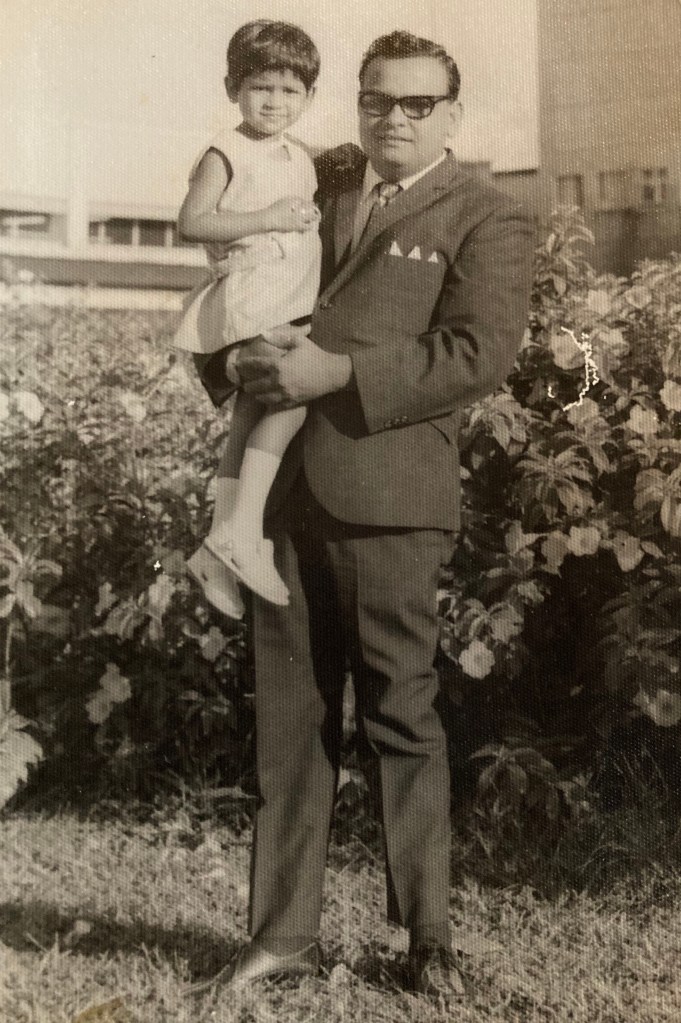
I still have the pictures that we took at Piarco airport the day that my father left for the United States.  It was 1969 and we got all dressed up to go to the airport.  My grandmother, grandfather, aunts and cousins, pretty much the family village all came in a caravan to the airport; they even hired a photographer to take pictures of this momentous occasion.   In Trinidad, at that time, going on an airplane was serious business as travel was uncommon.  My father bought a new suit and a fancy Eccolac briefcase for the occasion.  He wanted to paint the picture of a businessman going off to a better life. To that end he mysteriously had my sister take a piece of white rectangular cardboard and cut it into a zigzag pattern and this he placed into the outside breast pocket of his suit jacket and headed off  into his new life.  It wasn’t until years later looking at the picture that I realized what he was trying to do.  Apparently, he was trying to imitate the pattern of a handkerchief in his breast pocket. He had seen pictures of elegant men in suits and noticed a zigzaggy pattern on their outside breast pocket, and looking at it two dimensionally, didn’t realize that it was a handkerchief.  He wanted so badly to look sophisticated that he wore a new suit, carried a briefcase, and ironically installed a piece of cardboard in his breast pocket to complete the ensemble.  Looking at the pictures today I wonder what people thought when they saw that piece of cut up cardboard sticking out of his pocket. I hope they were kind.

Immigrant Story part 2

In the early 90’s there were some murmuring at the University of Miami about possible cutbacks to the staff.  All the employees of my father’s department were herded into a meeting and assured that the cutbacks would not affect them.  A few months later my father was the only one laid off.  We were in a state of shock.  It was as if a wall had suddenly come crashing down on them.  The patriarch who supported the household and all the guests to paradise was suddenly unemployed.  The road ahead would be difficult.  Instead of receiving an occasional stipend from the parents we were mailing them extra money.  When we visited Miami, dinner was on us.  I was married during that stressful period and as a present my parents gave us a generous check.  My husband and I agreed to tear up the check; we destroyed it the night of the wedding and never discussed it with my parents. 

 Daddy now faced the daunting task of trying to find a job in his mid-fifties.  While most of his peers were looking forward to retirement Daniel was out job hunting.  This was a fruitless, humiliating, exhausting endeavor.  Age discrimination is alive and well.  He simply could not find a job even though he kept lowering his sights and salary requirement and was eminently qualified or over-qualified for most of them.  My parents knew the solution—his age would have to be disguised, but how?  One day as they watched TV they saw the infomercial for “Hair in a Can.”  It miraculously made you look 10 years younger with one spray.  Daddy started losing his hair in his mid-thirties and by his mid-fifties he had the hairline of a Franciscan monk.  Everything in the middle and top was gone and he had a ring of meager gray struggling to surround the crown of his head.  My mother sent in her $19.95 and got a can and a free set of knives.  The day before my father’s next job interview she whipped out the can.  Mother started spraying with my father as her first willing, desperate client.  The hair went on like black spray paint and, instead of a head full of luxurious curly hair, Daddy now had a painted head.  Mother tried for a while to scrub and scrape away the paint and then resorted to nail polish remover, neither of which was effective and, at most, it diminished the look from bald and gray to speckled.  “Hair in a Can” was hair to stay… and my father was forced to go to the interview looking, not younger but, like a freak.  He offered no explanation and no one had the courage to ask what happened to his head.  Surprisingly, he didn’t get that job. 

A few months later, however, he obtained a job of repairing small appliances at a Black and Decker storefront.  While his salary was small he seemed to enjoy the simple repair work.  Because the appliances were low priced, he was only allowed to attempt a repair for a short time period, something in the area of half an hour.  If the repair could not be completed the appliance would be thrown in the back dumpster and the customer would be given a new appliance.  Growing up poor gives a person a dislike of waste, therefore, my father spent his time after work dumpster diving.  He brought home dozens of irons, cordless screwdrivers and other small appliances.  On his evenings and weekends he would spend hours repairing the items.  Every family member had closets full of irons, hand mixers and cordless screwdrivers.  

Daddy’s last job was working for the Florida Dept. of Transportation.  He was relieved to get a job with the state as it provided good benefits.  He again had insurance and retirement benefits, however, the big house in Miami was sold for a more modest ranch in Coconut Creek; the beloved boat was gone too.   He was looking forward to retirement, desperately; as I think he was tired with the battle of working.  His feet bothered him and his hands and back ached.  He was no longer the young, strong man he used to be and tried as hard as he could to keep up with the younger guys at work, even cutting out pieces of foam to act at insoles in his work shoes so he could walk more comfortably.  His job was to repair toll machines on the Florida Turnpike.  If a machine jammed or refused to count the coins tossed into the basket, he was dispatched to repair it. His plan was to hold on for three years so he could finally have the retirement he’d dreamed of.   Unfortunately that dream never materialized; it was at one of these assignments, at the age of 62, that Daddy had his final heart attack.  His supervisor found him slumped over the front passenger seat of his work vehicle at the side of the toll island in the Everglades.  It was a beautiful, sunny August day in 1998 when he went to his final rest.  I remember thinking of how he would tease me about being so devoted to planning.  He would say, “If you want to make God laugh, tell him your plans.”

Immigrant Story part 1

Our family immigrated to New York in the 1970’s and it was a challenge to financially support seven children and both Daniel and Sylvia worked hard, long hours to do so.  Many necessities had to be cut out such as medical and dental insurance. Luxuries such as restaurants, vacations, trendy clothes were never in the equation. 

The wheels of fortune finally turned in the early 1980’s.  A company who made electronic exhibits and displays employed Daniel, who possessed an innate ability to repair almost any appliance.  One of their more famous displays was the laughing, fat lady at Coney Island.  Later the company was involved in the Hall of Presidents displays at Disney.  The company gained a reputation for making animated characters.  As a result they became involved with a heart simulator machine, used to train cardiologists, produced by the University of Miami.  My father was the expert at assembling and repairing this expensive medical tool and it became clear that there was a job opportunity at UM for such a person.  The only issue was that Daddy never graduated high school, although he did receive his GED at a local community college in Queens in his 40’s.  While he was qualified for the position he did not possess the resume befitting someone for that high level position.  The Cardiology Dept. of such an esteemed university would never hire a high-school dropout.  I remember my father on the telephone with a coworker on the project from California as they conspired to get daddy the job.  His friend in CA produced a beautiful resume for my dad that was almost entirely fictional.  His resume bragged that, in addition to completing high school, Daniel had gone on to the University of the Caribbean and obtained his engineering degree.  His qualifications were stellar and he was offered the job. 

Mother quit her job at the bank; they sold the house, and moved down to Miami.  They bought a big house with a swimming pool, separate living room, family room, two car garage, screen house, intercom and a master bedroom with an en-suite that they didn’t have to share with seven children.  Daddy made more money that he’d ever made in his life.  Mother no longer had to work and the family had health insurance, life insurance and a retirement account.  Three of the kids moved with them and the rest of us came to visit them in paradise as often as possible.  This was a time of South Beach adventures, Coconut Grove explorations and weekend trips to the Florida Keys.  Mother and Daddy traveled all over the world installing the cardiac simulators.  We have pictures of Mother sitting on a camel in Egypt, Daddy having sushi in Japan, both of them standing at a castle in Norway, smiling in front of the Eiffel tower etc.  This was the peak of our family life and Daddy bought his first of several boats that we would pilot to sun and fish in the Gulf Stream.  We had happy times, money, travel and health.  There were Christmas presents every year and my parents were generous because they could afford to be.  It was an amazing immigrant success story.

Unbecoming Jane

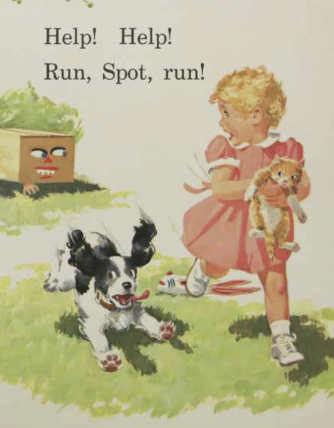
I had been trying to become invisible since I moved to Queens Village, NY in 1974.  Since no one else looked like me, it was confirmed that my look must be wrong.  Even in my three years of schooling, on that tiny island of Trinidad, the literature, based on the colonial British school system, was replete with images of Dick and Jane who had the gift of light colored hair that flounced around as they chased their bright colored ball with their dog Spot.  “See Spot run, run Spot run” was the enigma of my childhood.  No one I knew had anything but black hair and had never had a dog named Spot.  But, if this was in the literature taught in school it must be correct. How could this basal reader that gave me the magical gift of reading be flawed?  Ironically, If I wanted to have an authentic life I believed I had to hide and embrace the majority thinking.  This was drummed into my nascent brain who did not yet have the power of challenging popular paradigms. Moving to the states only confirmed that, with my Jane clouded vision, real Americans all have long, blonde hair.  I entered the 4th grade feeling like the only crow in a lake of swans. Therefore, I decided not to speak in public places such as classrooms in an attempt to hide my different-ness.  I did not feel as if I had anything material to offer.  This self-imposed silence was easily accepted by my peers and teachers as they assumed that English was not my first language and I grew comfortable in the stillness.  I deduced the secret of my academic success, don’t say a word but pass all the exams and you can continue to be the “silent observer” as my Communications professor at Queens College labeled me in 1983.  My black hair became the inky cloak, as Hamlet eloquently put it, that rendered my invisibility and comfortably closeted me.  In my 20’s and 30’s I started coloring my hair, not to cover the sprouting greys but to lighten my hair.  I thought that changing my stark black to a dark brown would be more fashionable and lessen the severity of my Indian hair.  Indian hair was not fashionable and, by extrapolating this, neither was being Indian.  This was my first foray into the mainstream to become Jane.  I began dating a Richard, who was to become my husband, and at age 28, the night before our wedding, I colored my hair to a dark brown to look acceptably beautiful for the requisite pictures.  Some might consider this the epitome of becoming Jane, albeit without the required canine.  However, I was at an age where my I was starting to question my beliefs.  Although I was a brown haired, college graduate, homeowner, who worked at an international bank, Dick’s parents refused to attend our wedding ostensibly because I wasn’t Jane enough for their standards.  And, in a well thought out gesture I decided not to take my husband’s name.  I was slowly starting to realize my own worth.  Singh is an ancient, proud name and I was reluctant to leave it behind and assume an Irish one that would mask my ethnicity, as least on paper.  This step was the beginning of a long journey, as are all, into my being comfortable not being Jane.