Daddy’s 85th Birthday

Dear Daddy,

My first memory of you is a time when you came to visit us in Trinidad after you had moved to New York.  There were smells of chicken and roti, rice, beans, and bottles of Solo waiting for you.  You entered through the front door like a celebrity, much better dressed than a prodigal son.

It’s been 23 birthdays since we lost you and sometimes I pretend that you are still living in that prized house in Miami with the enormous swimming pool surrounded by the pebbly Chattahoochee, expansive lawn, suicide door Cadillac and the Dansyl patiently moored in the circular driveway.  I can picture you now with your striped button down shirt slightly straining that third button above your belly, colorful Bermudas complemented with brown socks and dark shoes; totally rocking the immigrant look, as you zip by on the riding lawn mower. 

I reflect on all the things that you taught me:

  • Be adventurous and hopeful, move to a different country or state or town in times of uncertainty and opportunity
  • Be unapologetically bold with colors and clothing.  Be a Sagaboy and wear that gold tooth cap driving the orange car
  • Embrace new job opportunities
  • Approach life with a sense of humor; dad jokes are always funny
  • Go big; a little is good but more is always better
  • Alcohol can change you from a kind, loving person to a …
  • Dance; don’t be afraid to move your hips
  • Enjoy loud music and share it with your kids; especially when they’re trapped in the car with you
  • Spend money on luxuries and be generous
  • Put sunblock on your bald head
  • Keep learning and teaching yourself; any appliance can be repaired
  • Don’t pay retail prices; negotiate
  • Always have a battery tester
  • Socialize; meet your neighbors, try new foods, travel everywhere
  • Enjoy every meal, eat with enthusiasm and bring your own hot sauce
  • Improvise, improvise, improvise

Your best piece of advice, or maybe a glimpse of your bravado, was when I had started a new job and was living on my own and confessed my anxiety to you.  Your response, “You can’t be afraid of anything, you are MY daughter.”

I remember how you used to tease me that, because of the skin discoloration on my leg, I was the only one of your children that came in Technicolor.  Our last conversation was a few weeks before we abruptly and unexpectedly lost you.  Normally we would exchange a few quick words across the miles and you would pass the phone on to Mammy; but this time you stayed on and as we talked you remarked, “I’m so proud of you, you are a daughter after my own heart.”

I wish we had you with us longer.  You should see your grandkids; you would be so proud; they are so successful and good and beautiful and everywhere! – California, Colorado, Delaware, Pennsylvania, Virginia, Florida and New York! 

Did you send those butterflies when we spread your ashes in the bay? I hope you did; keep in touch 🙂

Love, Luxo

Momisms

In honor of Mother’s Day I thought it would be appropriate to share some of the pearls of wisdom that have fallen out of my mouth raising my children.

  • We are a sharing family
  • NO
  • Stop licking the fish tank
  • You can’t pick homework to give up for lent
  • Go ahead, punch your sister
  • One day you’ll wake up and realize you’re Indian and there won’t be any hot sauce
  • Don’t be the smelly kid
  • Do it now
  • I invented that
  • Yes, your sisters are mean
  • What’s with these grades, have you forgotten you’re Asian?
  • Why did you unfriend me?
  • Don’t fall for the marketing
  • I don’t know what to do
  • Sure it’s ok to get a pet goat, turtle, (fill in the blank); they’re delicious
  • Expiration dates are just a suggestion
  • I’ll give you a dollar to clean your room
  • The mailman or newspaper carrier is your real dad
  • Who is raising you?
  • I’m too young for this
  • Yes, I know it’s 3pm (me wearing pajamas)
  • Two out of three have to agree
  • I’m not laughing AT you
  • It’s ok, it’s called day drinking
  • Stop getting tattoos
  • You have velvet pants AND suspenders?

And most important,  

  • Be kind, keep in touch and support each other; one day you’ll be the only ones who share your childhood memories

Pet Rocks for Sale

Queens Village in the 1970’s was an idyllic place to grow up.  When my sisters and I arrived in 1974 it was an entirely new world for us.  Housing developments were an enigma because who would want a house that looked exactly like their neighbors? We were too young and unsophisticated to comprehend the cost savings and building efficiency of a planned neighborhood.  After our first weeks there we were greeted by the twins living in the original farmhouse on the corner across the street.  Theirs was one of the only houses that were unique on the block with a screened in porch, basement to attic living spaces, real fireplaces and a woodshed on the side of their property that was roomy enough to serve as our occasional dark and creepy clubhouse.  How they knew we had just moved in I’m not sure since our older siblings and parents had been there for a few months before us younger ones joined them in America.  The neighborhood grapevine that caused a selling frenzy was probably abuzz with the three new Bees that had just joined their family at 92-07.  The twins came over to introduce themselves and brought over a bird with a broken wing they had recently rescued as a conversation starter.  We became fast friends and soon realized that we attended the same Elementary School, P.S. 135; loftily known as The Belaire School.  We would do homework together on our stoop as we were not allowed to leave the yard and my mother never allowed friends inside the house.  We happily complied and spent all the warm days of summer playing in the yard or the street.  Summer provided more time for ingenuity and profit making.  We engineered a scary house tour where our blindfolded neighborhood friends would be led on a ghost tour, by touch only, in the backyard for .25c apiece (afterwards we refunded some money, not because of complaints, but because we felt the tour was too expensive).  Next, we glued pictures and handwrote magazines (I think my sister Bernie was an unpaid intern with this business venture due to the amount of copying) and sold them to the neighborhood kids. 

One summer we realized that we could capitalize on the Pet Rock craze that was sweeping the nation.  There was essentially no overhead as we could gather all the required materials from our yards and have a pet rock sale.  We searched around and found the best specimens of varying sizes and rummaged through our closets for materials to adorn the rocks.  We glued seeds for eyes, put a fur cape on another from a scrap of rabbit fur someone had, and painted designs on others.  The optimism was palpable and our neighbor Bobby decided to join our endeavor.  As Bobby was the best artist on the block he was given the largest rock to decorate.  It was enormous and was probably rescued ballast from a long ago sailing ship.  Bobby cleverly designed the rock as a ladybug.  He painted it red with a white face and plentiful black polka dots over the body.  He found some wire and twisted antennae to the front of the face.  It was a thing of beauty and would be our centerpiece.  We met to plan the advertising and, seeing that people attached garage sale signs on trees and poles, we decided to do the same for our pet rock sale.  We created flashy signs advertising a pet rock sale at 92-07 and posted them all over the neighborhood.  We were marketing geniuses! That is until my mother got wind of it.  “You put signs all over the neighborhood inviting strangers to our house?” “Well, yes we did because we are marketing geniuses.” Later that night with my older brother guiding us with a flashlight we scoured the neighborhood grudgingly removing our flashy signs.  The next morning our crack team met for a reconnoiter.  We decided to have the sale but move the location to the twins’ house across the street since their mom was more supportive.  We set up a table in their front yard with a big sign “PET ROCK SALE” and waited for the hordes.  Our rocks were priced by size and intricacy of design from .5c to .25c and finally a budget busing $1.00 for Bobby’s beautiful ladybug rock.  And people came, not the droves that was expected, but we had a trickle of curious customers. Our biggest supporter was Bobby’s grandma who quickly sent over $1.00 to buy her grandson’s prized ladybug.  We debated whether we should charge her but that dollar was just too tantalizing.  In all we probably made a whopping $2.50 that day.  After the sale we had a heated discussion about what to do with this windfall.   We decided a candy picnic would be most equitable.  So, we took all of our pennies, nickels, dimes and dollar bill and triumphantly walked over to Helen’s Candy Store.  Helen’s was a neighborhood icon filled with shelves of colorful, loose penny candies and an ice-cream counter where for a rarely afforded  .25c you could get a scoop of the best tasting ice-cream on a crunchy cone.  The only downside was that you had to put up with surly Helen when you walked in.  She would bark at you if you took too long looking and was just overall marvelously grumpy.  We spent all of our earnings and left with a paper bag full of candy.  Then, we set up a blanket on the twins’ front lawn and joyfully feasted.  I don’t remember if we invited Bobby. 

Nadine

Awkward, shy and pimply; I had one saving grace – academics.  Mr. Marcus returned my test paper – 95, well done!  Nadine commented loudly from three rows away, “I don’t know why she got two points higher than me.” A Cheshire cat grin pointed my way just to show she was kidding. Many tests had similar outcomes, with me getting slightly higher grades than Nadine.  I thought nothing of it, perhaps because my grades were higher, but Nadine’s snide comments continued, “The teacher probably just likes her more” or “I know I’m smarter than her.” They weren’t bullying comments as many are bound to conclude, they were simply bitter, hurtful attempts to assuage her jealousy and insecurity.  I was too young to realize this and too shy to say anything.  I wanted the remarks to stop and used the approach of ignoring her comments, which didn’t work.  It just made me feel weak.  I craved getting back at her yet had no tools in my armory; but Nadine had it coming. 

One of my favorite quotes is from The Alchemist, by the Brazilian author, Paulo Coelho who wrote, “When you want something, all the universe conspires in helping you to achieve it”

At the end of 9th grade we were both inducted into the Arista Honor Society at our Junior High School.  It was an elaborate, formal ceremony held in the auditorium. Our families were invited to the auspicious occasion marked by ritual.  We were awarded pins and were required to wear long, dark robes.  The ceremony opened with all the honor society inductees marching in silence, in the dark, down the aisles to the stage.  To illuminate our path we were all given tall, white candles.  All the lights in the auditorium were dimmed and we lit our candles and walked slowly and somberly to the stage.  We held our candles at our breast with the glow just slightly illuminating our faces.  I marched a few paces behind Nadine.  She was so proud to be recognized for her intelligence that she held her candle extra proudly.  And wanting to make sure that her face was visible held her candle slightly higher than recommended.  Midway down the aisle the marching momentarily paused and there was a commotion ahead of me with a flurry of teachers.  Apparently, Nadine, holding her candle a little too high had set her bangs on fire.  It wasn’t a very big fire and was quickly doused by some quick thinking adult fingers.  Our march resumed shortly thereafter and we all walked proudly on stage.  I slyly peered over at Nadine to my right.  She was surreptitiously plucking at her hair.  In fact, she spent the rest of the ceremony sniffling and quietly picking at the burnt edges of her bangs.  Back in class the following week and weeks till the end of the school year I don’t recall if she ever threw any barbs my way.  She may have but the effect was gone.  The universe had conspired to get me what I desired and it wasn’t a dish served cold, rather it was flaming.  

Monday’s Child

Monday’s child is fair of face and, she is; when the nurses brought her to me they told me she was the prettiest baby in the nursery. But she wasn’t the quietest. She started screaming early and often. The babysitter christened her “Screaming Mimi” and said she would only stop screaming to sleep and eat. The other parents would cover their ears and rush their kids out of the house at pickup time. Miss Sherry, her babysitter was a tough and practical woman who probably suffered hearing loss. One day I arrived to pick her up and was startled to find that her diaper was duct taped shut with many, many crisscrossed pieces of tape. Earlier that day my daughter learned to remove her own diaper and decided to, euphemistically paint, but, more accurately, slather her body and her playpen with her poo. Shortly after, around two years old, she learned to undress herself fully and casually strolled naked into the living room to greet our newspaper carrier Aldrich, ignoring my embarrassed, urgent whispers to get out of sight.

She’s always been a good eater. After she got the hang of eating rice cereal she wouldn’t close her mouth till it was filled. She knew the feel of a full mouth. She’s a messy eater and, even now, I can always tell what she’s eaten by looking at the smears on her face. Her first restaurant outing was to a Chinese restaurant in Miami. She loved the food and then proceeded to have explosive diarrhea all over my lap. Her body has no tolerance for greasy food. On our last outing together we had delicious pizza at Artichoke Basile in the East Village and, afterwards, she threw up multiple times, feeding all the trees, along 34th street. She did it with grace and style, barely pausing our conversation.

The little traitor’s first words were, “dada”.

She tried to play the violin in elementary school and again in high school. Mr. DiPaola asked for his violin back. She appreciates music though and plans on marrying a musician.

She wants to be a leader. When she was four she came home from the sitter’s heartbroken and crying because her friend, Devan, had called her a copycat. She loves being a big sister. She announced, right before her brother was born, that he should be named “Macaroni head”. She has a little sister that she sometimes butts heads with but that she knows she can always rely on. On her first day of kindergarten and college I sent her off with a small piece of “bunbun”, her blankie, to make sure that she had some of the comfort and security of home with her.

She’s had good role models and, thankfully, is surrounded by tough, resilient women. The irony is that I’ve raised her to be independent and am so surprised and scared when she is so independent. She makes big decisions and moves forward through college, jobs and now states. She’s a strong woman with a capricious temperament and although I’m sometimes afraid of her 🙂 I’m always incredibly proud of her.

Because you asked…

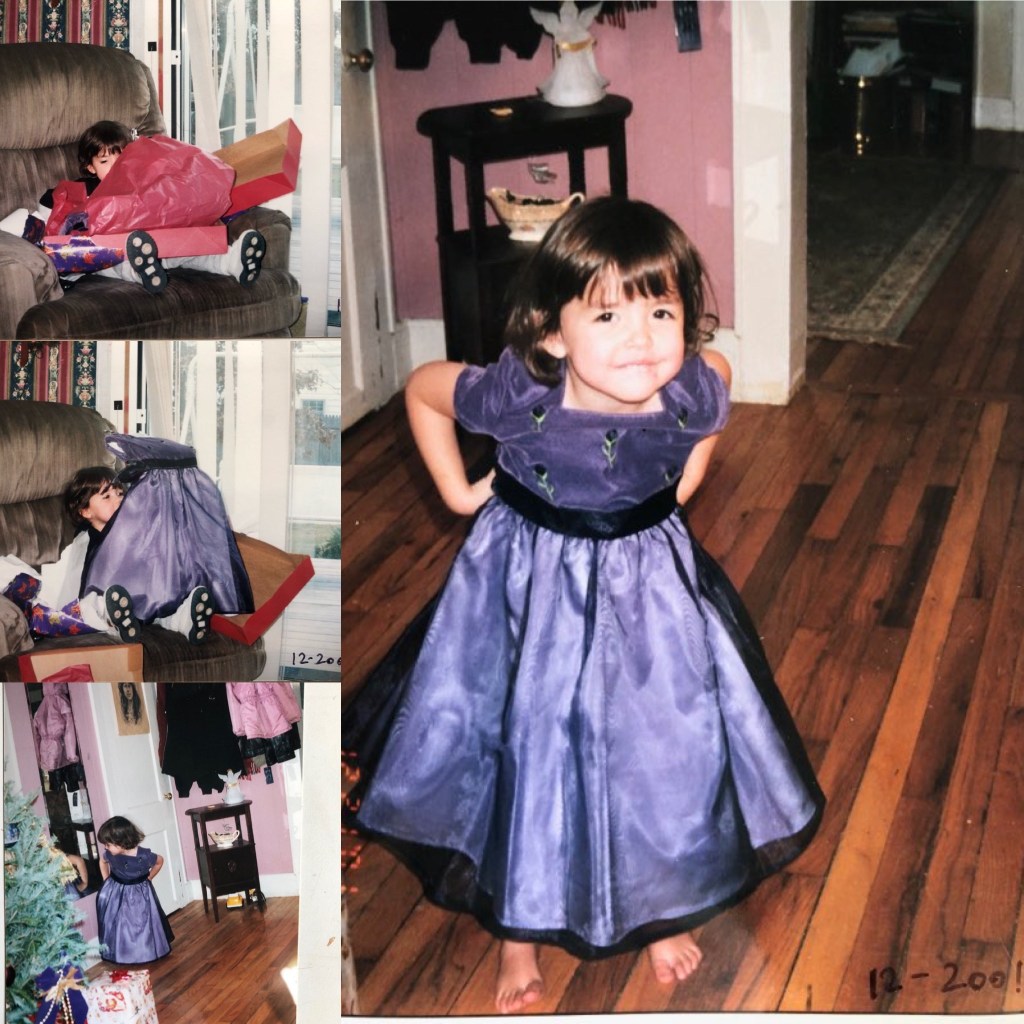
She was born at 30 weeks and weighed 4 pounds.  We were so careful with her but she found her way into the dirt and ate snails and car wax while we were not looking. When she was two, her aunt bought her a purple velvet and taffeta dress with satin ribbons.  She twirled and twirled in front of the mirror and wore the dress daily, even sleeping in it.  Every few days we’d have a negotiation to get it off and into the wash.

She is always asking questions.  “Mom, what would happen if all the cows in the world couldn’t give milk anymore?”  “Mom, what if a tree fell on the house and we weren’t home and we came back and went inside?”  And the ubiquitous statement, “Mom, we should get a dog.” When she was five we took her to Disney for the first time.  We lost her getting off the Dumbo ride, and it wasn’t the last time.  She’s attracted to shiny things and will wander away when she sees something sparkly.    

She plays the trombone, almost.  When she shockingly picked it up in 5th grade it was bigger than her and I was secretly pleased because she didn’t pick the other “girly” instruments.  She keeps forgetting to practice and, when she does play, it is so faint that no one can hear.  

Soccer was a challenge.  She refused to kick the ball and it would only make contact if it accidentally hit her shoe as she moseyed across the field.  Then, we decided on dance to keep her moving.  She learned the Train dance, had one recital and never looked back, so we returned to sports.  Softball is not her forte.  Whenever she’s at bat, the only sounds I hear is her coach yelling, “awwww come on!!”

She broke my heart at eight when I proudly presented her with a new outfit I’d bought that day.  “You know mom, I’m not into Dora anymore” she said, not too unkindly, and quite patiently.   Nevertheless, there was this smashing, splintering sound and, if I let my mask slip, on the inside I looked like the timeless Munch artwork, The Scream.  It was that instant of recognition, the epiphany of the childhood rite of passage and just like that my little girl was no more. 

Last night, as I was sitting on the corner of the couch, she came over and insinuated her body between me and the arm and burrowed under the blanket with me.  My little girl was back and finally cuddling with her mom.  Then she said, “Mom can you move because I need more room to stretch out.”

On Your Birthday 2/4

Dear Mother,

My first memory of you is the two of us sitting in the hammock downstairs in our house in Trinidad.  We have just finished breakfast of roti soaked in milk and all the other kids are sent off to be indoctrinated at McBean Presbyterian School.  It is late morning and we rock slowly, sitting side by side reading a story from a giant hardcover book.  I feel special, an only child.  The day is peaceful with the occasional car passing on the Southern Main Road. I beg you to read the story over and over and you patiently indulge me.  There was this girl who lived in a garden… I don’t remember much about the story but I remember the feeling.  I always remember the feeling –quiet and love and melancholy. 

I miss you most when I see how my children have grown, despite your long absence of now 18 birthdays. Do you know that Bethany is living in Colorado and threatening to get married and has a cat AND a dog? Do you know that Brayden is so smart and hardworking and watches terrible reality TV and graduating college in May? Do you know that Rick has a wry sense of humor and a beard and can fix things just like Daddy? They all have your soft spoken, shy way about them and also your fierce determination but I hope that they know their worth.

I think of you often and reflect on the lessons that you taught me:

  • Look cool and stylish – Wear your best clothes and pose in sunglasses for pictures, even if you’re standing in the yard in front of a latrine.
  • Wear jewelry– bracelets, rings and necklaces, particularly gold ones
  • Grow some of your own food and flowers even if it has to be in pots
  • Going out to restaurants is a joy; go as often as possible
  • Save all your pennies
  • Be generous to family with your time and money
  • Support each other and share, split everything seven ways
  • Some days you’re a single mother with a husband, deal with it
  • Learn arts and crafts
  • Read romance novels
  • Bear your pain in silence
  • Keep up the struggle to lose weight
  • BUT always leave room for dessert

Your best piece of advice, “where there’s good there’s better,” said encouragingly whenever I lamented a failed opportunity. 

My last memory of you is not your lying prone and swollen on a hospital bed on Christmas Eve, with air pumped by a machine into your lungs, because that was not really you. My last memory is visiting you in Margate at your new condo with furnishings that you refused to change because you wanted to keep all the “white lady” decorations to show how you had come up in the world. There you are, sitting on the couch covered by your grandkids in a huge snuggle fest, watching TV wearing a house coat with pockets filled with Nilla wafers. Later, as we leave to head back north you stand in the early morning light leaning over the railing just outside your door, lonely, waving down to us, straining for a last look. As a we drive out of the complex I feel an immense sadness, I recall looking up at you and your solitary life, punctuated by occasional family visits and fast food deliveries; wondering if it was the last time I would see you. I always remember that feeling– quiet and love and melancholy.

Love, Belinda

Happy Birthday 💕 I know there’s some debate about your age when you died. Were you 68 or 70? I really hope it was 70. I hope you had two more years.

Mr. Hernandez

“Why can’t you be more like Mr. Hernandez?” My mother quipped to my father as he indolently spent another Saturday afternoonlying across the sofa watching a boxing match. George Forman was attempting to wrest the title yet again from Mohammad Ali. After the match was over Daddy yelled for one of his seven children to scurry to the living room to hand him the remote from the coffee table, two feet from the couch, so he could change the channel. He thought, just maybe, there was a Jack Palanance western on channel 7.

Mr. Hernandez, on the other hand was outside his neat, cape home on a ladder industriously cleaning out his gutters. He’d spent the afternoon weeding his driveway and making minor repairs to the façade of his home. We had exactly the same home in the development in Queens Village. The only difference being the Hernandez’ house was well kept and ours was, well, lived in.

Every Saturday during the summer would find the conscientious Mr. Hernandez outside making his home immaculate with his efficiently laid out garden tools in his neat garage. The Singhs, however, had a garage door that was falling down from disrepair and Daddy would be cursing, as he could never find his tools. There were oil spots on the driveway from when Daddy occasionally attempted to make an auto repair. The lawn showed uneven spots where one of the older children tried to cut it with scissors. If Mr. Hernandez wasn’t working then he was taking his two girls and his wife on a day trip to the beach or the park. They were everything a suburban family should be.

We lived in a wonderfully diverse section of Queens–Queens Village, not quite the affluence of eastern Queens on the fringe of Nassau County, or the strife of south Jamaica. We were somewhere in the middle. The housing complex was built sometime in the 1930’s and white families moved in and settled until the 1970’s when the minorities like us moved in. For $27,000 we got a three-bedroom, one-bath cape with an unfinished basement and the dubious distinction of causing a run on the quiet neighborhood. When the neighbors saw an Indian family of nine move in, the for-sale signs popped up like whack-a-moles. A Jamaican family moved in across the street, a Dominican family moved in to the left of us and a Haitian family moved in down the block.

To the right of us was the Hernandez clan. The fiery Mrs. Hernandez was Cuban and her handsome husband was Puerto Rican. The houses on the block were built with such cookie cutter precision that when we moved there in 1974 I would occasionally walk into the wrong back yard when I came home from school. Xerox housing was a new concept for me. In Trinidad, where I lived for eight years, everyone’s house in our village was different. Houses were built one at a time, to owner specifications. No one ever built a house exactly like his or her neighbor.

My mother held the Hernandez family in high esteem. They were the benchmark to which she would compare my non-cooperative father. Why can’t you be more like Mr. Hernandez? Look, he’s taking his family out for the day again.” “Why can’t you be more like Mr. Hernandez? Look he’s mowing the lawn.” Mrs. Hernandez was a hot number or as my father would say, “she was a good looking broad.” When she came over to speak to my parents her chest fascinated me. The woman had four boobs…four! I was ten and had an ironing board plastered to my upper body. I would stare at the chest as she talked and try to figure out how she turned two ample ones into two big jiggly and two little juicy ones on top. It looked like she arranged her bra so that the abundance would spill over and form another two pack. They were amazing in their motion and number.

One summer day Mrs. Hernandez came over with shattering news—Mr. Hernandez had a girlfriend. Many days after that revelation, she came over to speak to my father to vent, to ask advice, or to recount an argument. Mr. Hernandez, my mother’s ideal, had hooked up with a teenage floozy. The couple now had violent arguments inside, outside, on the phone, with relatives and at divorce court. The beautiful, model, poster family of our suburbia simply disintegrated due to infidelity. Mr. Hernandez moved out and all trips to the beach stopped. The outside of their house started to look like ours. Mrs. Hernandez was left with two children to raise on her own. As her only work experience was baking cookies, hosting birthday parties, making rice and beans and supporting the home front, she got a job as a barmaid on Jamaica Avenue. We never saw Mr. Hernandez again. The rumor was that he’d actually married his girlfriend and moved on to play the perfect husband in another performance on Long Island.

Working in a bar was a cruel turn of events. The homemaker with the apron became the working mom who stayed out at the tavern till the wee hours of the morning, while my older sister babysat the girls. She would occasionally tell stories of wearing a diaper at the bar because it was so busy that she did not have time to use the bathroom. And there were the men too. She was, of course, still a beautiful young woman with those four breasts. The Hernandez sisters lost their luster. We spent less time having tea parties on their lawn and playing kickball on the side street. They were the first broken family on the block and they were never able to recapture their loftiness. We had fewer things in common and our families drifted apart. The girls, left to their own devices, sadly became the kind of kids that we simply didn’t want to hang out with.

The last time I saw Mrs. Hernandez she was sitting in the front seat of a Ryder moving truck, with her girls, waving goodbye as she drove south to the friendly shores of Miami. I don’t recall who moved in when she sold the house. And I never heard my mother utter those words again.
Christmas Blessings

Our large brick and cement house in Trinidad was set up with the kitchen downstairs and a huge, almost empty, space punctuated only by a burlap hammock suspended from the ceiling and anchored by rocks tied to either side. It hung just outside of the kitchen and served as our downstairs furniture. Our main living areas, the railroad style bedrooms, the drawing room and the gallery were upstairs. The gallery was an upstairs porch accessed from downstairs by long cement steps (which could be dangerous as my sister Betty fell and cut her forehead and probably still has a scar today) or through a door from my parents’ bedroom or another door through the drawing room. We were very British and called our upstairs living room the drawing room. It was a large room with a table, which we never ate on, that mammy used for ironing our school uniforms every Sunday. The other half of the room had a couch and a rocking chair, both made of dark wood with large, colorful, rectangular handmade furniture cushions stuffed with coco fiber. We had a TV where we watched The Wonderful World of Disney every Sunday. Our gallery was a place of wonder and joy where we would count cars, gaze at the night stars, and I would stare at the moon, looking for the man who was supposed to be there. It was also where our misshapen, green plastic Christmas tree in Trinidad was erected. I remember the older kids putting up the tree and placing all or our toys underneath, especially the prized train set. On Christmas there was probably special food and some small presents but, although I can’t remember any particular Christmas gifts, I still remember the feelings, the excitement of Christmas and the expectation that Santa was traveling to our house on Christmas Eve.

Years later in Queens Village on one Christmas, in the 1970’s, my mother broke her arm and had to go to the hospital. The bill was expensive and my parents used all their available funds to pay the bill. This, of course, left them without any money for presents. My younger sister and I, the youngest in the family, impatiently counted the days and hours and minutes till Santa came. On Christmas Eve we slept on the downstairs couch so we could catch Santa. We didn’t, of course, but on Christmas morning we were overjoyed to receive a plastic Flintstones cooking set. It was so beautiful and came with four plates, cups and a frying pan. The box, when turned over, served as the stove and we tirelessly played with it for hours in the basement. We cut food up on the plates and served each other as Pebbles and Bam-Bam stared back up at us with their frozen smiles. We never noticed that we were only given the one present to share, as we were so overjoyed to have the set. We played together well and didn’t even argue over ownership.

As an adult something jogged my memory as I smiled at the thought of that play set. Suddenly it occurred to me that the Flintstones dinner set was the only present under the tree that year. My little sister and I were so preoccupied with the gift that I never noticed before that my remaining siblings received no presents. It took me years to realize this because the five others never said a word or complained about their gift less plight. Everyone remained silent so that the youngest could enjoy their gift from Santa. That was the true blessing that Christmas.

The Beginning

The history of my family goes back to India.  No one knows for sure from where in India we originated.  My maternal grandfather (whom we called Nana) indicated that his family originated in Kasmir.  However there has also been speculation that the Hindi spoken by that branch of the family indicates that we came from somewhere in the Utter Pradesh region in India. 

The Caribbean islands were populated by the Carib and Arawak tribes when the Europeans arrived. The tribes were shortly decimated by slavery, disease and war brought on by the newcomers. The Europeans, who settled there, quickly took over and established plantations for growing cane, tobacco, cocoa etc. The labor pool utilized were slaves from Africa (after all the aboriginal peoples were annihilated). This enabled the planters to thrive until slavery was abolished in the British Empire in the middle of the 19th century. The freed Africans, tired of working in the plantations, moved to the city and left the planters without a labor force. Trinidad at that time was a British colony. Concurrently, India was also a British colony. Therefore the powers that be decided to glean their laborers from the significant pool of people living in India. The Indians were offered Indentured Servitude contacts….barely discernable from slavery. They would be provided passage to Trinidad via ship and when they reached Trinidad they would be housed in barracks on the plantations and work the cane fields. The barracks were a series of railroad rooms occupied by entire families. It’s difficult to describe how claustrophobic the barrack environment was. To give you some idea of their size, when my grandfather purchased an estate in the 40’s he turned the barracks on the property to a pen for animals, primarily pigs. The contract was for a term of five years and the laborers earned approximately 25 cents per day depending on how much cane they could cut in a day. At the end of their contract they were given the option of passage back to India or they were allowed to trade their passage for a small amount of land. My ancestors chose to stay (however, there is no evidence that they ever received any land).

The process of immigration from India to Trinidad seems fraught with confusion; either by choice (people fleeing from family or the law) or chaos (not knowing the language and getting on the wrong ship), families were split up and traveled on different ships not knowing which was bound for Jamaica, Guyana or Trinidad. Therefore, our family in Trinidad seems to be matriarchal on my maternal side as only the women landed in Trinidad, sans husbands. I have a deeper understanding of my mother’s side of the family (the Ramserrans) based on conversations with my mother’s father (Nana).

Nana’s mother (our great grandmother) kept cows and she would have to wake before dawn to milk the cows and walk miles (in the dark) to deliver the milk (to the mayor of the village) so that he could have milk with his morning tea.  She did this every morning (no days off).  The mayor demanded a monthly statement (even though he could count the days of the month) before he paid her and since she couldn’t read or write Nana started to write out the statements.  Nana signed the statements ‘Daniel Ramserran’.  When he received the statement the mayor asked who Daniel Ramserran was…Nana’s mother said she had a son named Ramserran but she didn’t know who Daniel was.  The mayor said that her son must be Christian with a name like Daniel.  That’s how she found out that Nana had converted to Presbyterianism, and she was none too happy!  Apparently only blacks were Christian back then.  So she went home and yelled at Nana and asked if he was becoming a ‘creole’. In Trinidad it was in your best interests to convert to a Christian faith and adopt a Christian name if you wanted some measure of success.  Missionaries came waving bibles and saw to it that as many heathens as possible were converted.  Their aid came with a high price tag.  In exchange for medicine and education many Indians had to give up their religion and with it their heritage and culture.  It was a struggle for the first generations from India to give up their identity and yet they knew that unless they embraced a new religion and culture their success on the island was limited so Ramserran became Daniel. When Nana was in his 90’s I went back to Trinidad to visit him. I asked, “Nana since you were raised with both Hinduism and Presbyterianism, what religion do you really consider yourself?”  His answer to me was “Don’t all rivers run to the sea?”

Nana had formal education up to a point.  When he was growing up he was schooled in the British education system in Trinidad.  This system commanded that male children wear pants to school, regardless of their cultural or economic background.  Therefore Nana’s family was forced to purchase a pair of pants for school.  This was no small feat as funds for this was non-existent.  He wore the same pair of “Charlie Pants” as he called them to school every day and periodically would wash them and place them by the fireside to dry.  Unfortunately, one day he placed them too close to the fire and they burned.  That, sadly, put an end to his formal education as he could no longer adhere to the dress code, however, at that point a neighbor offered to teach him so he gained his literacy.  His early career ran the gamut from chip-chip gang member (children who do odd jobs in the fields) to Bull Cart driver, to sugar cane field laborer.  He was married very young, twice.  In those days the children’s marriages were arranged at a very young age, when the families came to an agreement.  The families would hold the ceremony but the children were not expected to live together until they were adults.  In Nana’s case his family quarreled with the family of his first bride so they married him a second time to someone else.  He did not meet his wife again until he was an adult, about 20 or so and saw her at a social event.  It was then that they decided to set up a home together.  They worked the cane fields together and in all had eleven children, nine of which survived to adulthood.  One died as a baby and another died as a toddler, the deaths were not diagnosed, but by the symptoms described it may have been a fever or influenza.  There were so many reasons why people died in that era, most of which have been eradicated now.  My great grandfather died of what Nana described as ‘bellywork’  which I took to mean dysentery. 

The indentured servants traveled in the belly of the ship in steerage, in cramped, difficult conditions. My maternal grandmother (whom we called Nani) was born, on the ship, on the six month voyage from India to Trinidad. I don’t know much about her childhood but, as adults, after they established their household, she and my grandfather worked as laborers in the sugar cane fields in Trinidad. Nana told me once that they were required to cut “a task” of cane which would take all day, and be paid .25c, only if they finished. Most days he could finish his task then go help Nani so they would earn .50c daily. They saved these pennies and started a small dry goods store in their town and from the proceeds of this store were able to save enough to buy their own (365 acre) sugar cane estate, named Mayvale. The shop did so well (possibly due to Black Market business during WWII) that bureaucrats came to investigate one year, but upon seeing the run down shack of a store, resolved that it was probably a mistake and left my grandparents alone. Subsequently my grandmother was left to run the shop during the day while my grandfather worked on the estate. In the last conversation I had with Nana before he died I asked him many questions about his life. I guess at the time I foresaw that, as infrequent as my visits to Trinidad were, it was probably the last time that I would be seeing him alive. He described to me how he and my Nani ran the shop without her being able to read or write. Most of their sales were done on account. Customers would come in and charge their groceries to their account until they were paid. Moreover, at any given day and time there were customers coming into the shop purchasing items for cash, on account, or paying off all or part of their balance. Nana said that Nani would mind the shop all day and when he came home at night, they would sit down, and he would record the day’s events. Since Nani was not permitted to attend school and was illiterate she would memorize all the daily transactions and recount them so Nana could record them. They must have been a formidable couple.