AJI

In Indian culture the maternal and paternal grandparents have distinguishing names.  In our family/culture Nana and Nani are maternal grandparents and Aja and Aji are paternal grandparents.  Therefore my Aji was my dad’s mom.  Her given name was Dulari (pronounced Dularee) and it means beloved or dear one tracing it origins back to Sanskrit.

Aji was a formidable woman.  She was a teenage mom and raised her children primarily on her own (supporting them with her real estate rentals); with the exception of my dad who was shuffled off to his grandparents and various relatives because his father was not the man she married.  So I’m guessing she was familiar with scandal and gossip.  Regardless, my daddy was devoted to her.  One of my earliest memories of her is when, I was probably around five, she traveled to our house in Couva and, with needle and earrings in hand, pierced the twelve earlobes of us girls.  I’ve since had my ears pierced again but the original asymmetrical holes are still open, fifty some odd years later.  She always wore catseye rhinestone eyeglasses, dresses and an orhni or gauzy head scarf.  If the orhni wasn’t on her head it was pinned across her shoulder and chest at the ready. She always had a handkerchief tucked in her bosom and generally her money was wrapped in the kerchief and tucked safely in her bra.  When we were quite young my mother visited my dad in NY and Aji moved in to watch the seven of us.  I distinctly remember two things about her stay.  The first was the delicious coconut fudge that she made for us.  I can still remember the coconuty sweet taste as we ate it still warm in the middle with a shiny crust on top, snatching at the crumbs.  The second, and maybe this is just urban legend, was her washing our cat.  The story goes that she tried to give our very dirty cat a bath and ended up with multiple scratches calling the cat a “mudda-ass” – that was her profanity word.  My dad would use it too when he was angry as both an adjective and a noun. 

She was a good cook, but instead of giving us the red mango or other treats she would carry in a basket on top of her head to sell at the schools during recess, we were the recipients of her “bush medicine.”  It was a noxious brown/green brew that she boiled up with herbs from her yard.  It tasted terrible and we would try to pour it under the table when she wasn’t looking.  I wish I knew what was in it today because I’m sure it’s probably a fantastic herbal cure-all that would sell like crazy.  Once at her house she showed me a weed whose stem could be chewed and used a toothbrush.  The lady knew her plants.

She gave us all our Indian middle names which I never appreciated and would try not to mention out of embarrassment when I moved to “no Indians in sight” Queens, NY 1970’s.  But she was right; we should try to maintain whatever little ties we have to our culture whenever we can.  She visited us in NY one summer and washed her underwear, placing them to dry on the bushes in the backyard right where me and my friends were playing; big old bra and panties drying in the sun.  I remember them being enormous, not because she was a big woman, but because my humiliation was so big. 

The last time I saw her was, in my 20’s, in Queens at my uncle’s house.  She had just had a haircut and a blowout and her silvery grey hair looked fabulous.  I have regrets, my main one being that I have no memory of having had a real conversation with her.  I always felt so different from her with her old lady ways.  Today I looked in the mirror and my glasses had rhinestones at the corners and my silvery grey hair looked fabulous.  I didn’t have a pocket so my cellphone was tucked securely in my bra. 
Boundaries

My children have always been very mobile.  The moment they left the safety of my arms they crawled, walked and ran away from me.  Eventually they acquired scooters, skateboards and bicycles and would try to press the limits of their freedom.  However, I would impose boundaries on their travel on the block and when they were mandated to turn around.  First, their movement was limited to riding up and down our driveway, then, after some pressure, to the Euczhscz’ driveway right across the street and back. I was nervous about that one because that driveway was sloped and they would careen into the street and maneuver sideways for a heart stopping turn.   After some deep reflection I bravely extended their boundaries from the Bellzer’s house a little further up the street to the Catalanos’ driveway—an entire three houses away; remember to turn around; go no further I would continually stress. Finally, as time progressed and after much pleading to increase their boundaries and, as they weren’t flattened by cars as feared, I imposed sweeping limits (imagine the sound of a flourish or cymbals)–stop sign to stop sign on our street; an entire block of freedom. There was a heart stopping point where I could no longer see them as they rode on their bikes all the way up the block to turn around at the stop sign. It was a complete act of faith. I would look out the kitchen window; stand at the front door or along the walkway and watch for them to turn around and make their way back. 

Today, they all have cars and passports and my first born is living across the country, fully employed with a fiancé and a fur family.  My second born is floating somewhere in the Atlantic, where I can’t even see her on my iPhone tracker, and my baby is poised to graduate college with a double major in Engineering and Physics.  So, at this point, with(out) trepidation, I remove all boundaries (imagine another flourish or cymbals)–You may officially all go past the stop sign and out to your future where I hope to catch occasional glimpses of your journey. Don’t turn around.

Keeping up with the …Ramkisoons

Our house in McBean was almost perfect.  Downstairs was open air with two big sets of double doors.  We rarely opened them wide.  They were large enough for a car to drive through, although, to the side of the house was an attached shed with a galvanized aluminum roof where, before Daddy moved to America, we stored our car.  The sound of rain on a tin roof is a beautiful, melodic, comforting sound. Downstairs was wide open with a Dutch door on the side that allowed us to open the top half for air and keep the bottom half closed for security.  We also had a big back door that opened to the L shaped yard with the latrin’, orange tree, fig tree and vegetable garden with the view of the cane fields.  All those doors kept the cement floors and brick walls cool during the hot months.  The tops of the walls had bricks with patterned openings to let the warm air escape and circulate.  Most months were hot or rainy.  We barely noticed the heat and when it rained we made hats out of newspapers, to protect our heads, and walked up Calcutta Road to school.  Daddy’s workshop was downstairs with a chair and a long wood table with his tools and soldering gun.  The only other furniture was a hammock which hung outside of the kitchen.  This wide open space allowed us to ride our bicycle (yes, singular since we all shared the one) inside and safely off the road.  The kitchen was a separate room downstairs, separated by another Dutch door, with a picnic style table and two benches where Mammy rolled out roti and prepped our meals.  Our sink protruded outside, on the wall opposite the door, with a single faucet, the backup pipe was just outside almost on the ground so we could get water in case we lost pressure.  Our modern kitchen had a stove and a refrigerator.  Outside we had a cement shower room attached to the kitchen and just outside the shower was a sink with a built in cement washboard.  Our toothbrushes hung neatly in a row on nails by the sink. 

How do we improve on this almost perfect house? Well, after little thought, we decided to add a water feature.  All the perfect houses that we saw on TV, on Sunday afternoons in the upstairs drawing room, had swimming pools and smiling happy people.  Therefore, our house needed one too.  The older siblings were in rare agreement.  However, to install this architectural miracle they had to wait for the owner to leave.  Eventually Mammy had to go to town and leave them in charge.  We all watched as she walked to the Southern Main road wearing a good dress, heels and lipstick, and held her hand up to flag down a car with a PH license plate, indicating that it was a taxi, and motored off to Port of Spain.  Shovels, spades, sticks and any available tools were immediately gathered.  We were a large family which necessitated a prodigious size pool.  Measurements were made using bare feet and the digging commenced; dig deep because we needed to dive.   The siblings had never got on so well with Mammy gone.  There were few arguments and nothing came to blows.  The need for a swimming pool unified them all.  No one considered that none of us could swim.  They dug for hours covered in dirt, enthusiasm and joy – imagining the envy of the neighbors and their friends at school and the refreshing dips in the pool after school and on weekends.  They had it all, that is, until the taxi pulled up.  Mammy, carrying packages, emerged from the taxi ostensibly to supervise and applaud the hard work.  It took her a minute to soak up the scene and the muddy, smiling, proud faces of the digging crew.  She was not amused by the surprise and failed to appreciate the depth of both the pool and the dream.  Everyone was ordered immediately to refill the gaping backyard pit.  There was shouting and crying and shoveling the rest of the afternoon.  The tears were enough to fill the pool.

Lead Me Home

Mammy called me at work on Long Island on a summer morning in 1994.  “Your Nana died yesterday, Tanti Basdai just called,” she sounded sad and lost.  Even though she was in her mid-fifties she still felt the pain of losing her daddy.  “Your father and I are going to fly down to Trinidad tomorrow morning.”  It was then that I decided to take a bereavement leave and go with her.  Losing a grandfather in the land of your birth is yet another strand lost in the ties to your culture.  I could already feel the fabric unraveling.  I left Port of Spain twenty-two years earlier and the memories of the eight years I lived there were faint and surreal.  In New York everything is well sanitized and prettied before it reaches the consumer, even death.  The few wakes and funerals I attended in my adopted country had been a very civilized affair.  People dressed in somber black and view a washed, preserved, well dressed and perfumed corpse laid out in a Cadillac coffin posed as if sleeping.  The family receives their condolences and after a few hours everyone gets to go home.  Nana’s sendoff would be different I knew.  Death is more of a pragmatic affair in the Caribbean.  True to the meaning, our family would hold an all-night wake staying up with the body in the parlor all night.  The coffin would be a simple wooden affair meant to decompose as quickly as the body.  Friends, family and the curious would come see look see that the old man is dead, drink black coffee prepared in a big iron pot in the yard and play cards to keep the family company in their all-night vigil. 

I flew down the next day and met my parents at the airport.  I walked off the airplane steps to the tarmac, greeted by the aromas of the island.  There was the usual humidity that slams into you as you step out of the air-conditioning.  The smell that greets you is lush, leafy and tropical mixed with the smell of the fires of burnt garbage.  It’s a not unpleasant scent but burns your nostrils with memories; memories of a childhood spent running barefoot on dirt traces past animals tethered to the backs of houses surrounded by cane fields.  The smell takes me back to harvest time where they would set the cane ablaze to rid it of the knife like leaves and any pests sheltered in the neat rows of cane.  The sky would light up a bright orange as the flames swelled over the cane.  The smoke and flames visible for miles and gave the yard an eerie reddish hue that cast long shadows.  After the fire the cane cutters would arrive, well before dawn, to slash at the cane with their cutlass and bundle them into waiting oxcarts before the heady heat of the day. 

The day of the funeral dawned hot and sticky.  I was one of the few relatives who slept as I had abandoned my mother and her sisters around 3am to find a bed.  A few minutes after putting on my dress and makeup I was dripping with sweat.  I was one of the few people dressed in black.  I stood out like the expatriate I was.  Most mourners came in their Sunday church clothes or dressed in white.  Nana was placed outside in the shade of the house for visitors.  He wore a stylish sorrel colored tuxedo.  In life he had never dressed in anything but dirty pants held up by a piece of string and an old sweat stained shirt.  In death he was dressed for the first time like the wealthy man that he was.  He was given a haircut and a shave.  He looked groomed and unfamiliar.  My uncle was furious because the funeral home had shaved off the enormous, gray handle bar moustache that he wore proudly for many, many years.  The funeral parlor said that the shaving was unavoidable because they had spilled something on his face and couldn’t get the moustache clean.  In the states they would face litigation, here we just shrugged our shoulders and carried on.  The mourners stood for prayers officiated by a Presbyterian minister, Nana’s adopted religion.  We sang Amazing Grace in unison in the shadow of the house.  The entire sendoff was held outside and had the air of a somber tent meeting.  Across the yard I am startled by Nana’s ghost – a man, the twin to my grandfather from the Fedora to the handle bar moustache.  I called my mother over curious to find out who the familiar stranger was.  She vaguely recalled that he was a cousin.

The body is loaded into an old station wagon provided by the funeral home to make its final, bumpy journey from The Garden, down Santa Clara Road to Couva.  The speakers on the top of the wagon blasts Jim Reeves singing, “I am tired, I am weak, I am worn, …Take my hand, precious Lord lead me home.”  The tune, which I normally laughed off as ridiculous, sentimental and old-fashioned, brings tears to my eyes.  At the cemetery I take pictures of everything.  The gravediggers even smile and pose with their shovels.  It’s a simple and quick affair.  There are some graves with wrought iron metalwork others with headstones and several with melted candles.  Many of the graves remain unmarked and you count steps or funeral mounds from the fence to find your long buried relatives.  We count to find Nani’s spot to see if the old man will rest next to her.  Is it six from the fence or five? No one is certain anymore.  In the 40 or so years that she’s been gone a headstone or an ornamental gate was never placed; there won’t be one placed on Nana’s grave either.  His body will be reclaimed by the earth and eventually no one will remember where he too is buried. 

The Smell of Sunday

Even though the estate was purchased early on in their marriage, the family never lived there.  Nana stayed  in Santa Clara to manage the day to day operation of sugar cane farming and came to visit his family in McBean often enough to ensure a baby every year, there were eleven births in total.  Nani carried on the shop and raised the children mostly alone until Tanti Basdai was old enough to help.  Nana would visit consistently to count and collect the receipts.  These visits were frequently acrimonious as Nani would try to hide and hold on to any profits to pay for household expenses but, after the occasional violent struggle, Nana would prevail.  The McBean house was one of practicalities but no luxuries; even mirrors, whose sole purpose was vanity, were nowhere to be found.  We were raised blissfully unaware of the history but knew the McBean house as a place of strict “sit down on a bag” rules imposed by Tanti, as Nani had died long before, while The Garden was a place of joy.

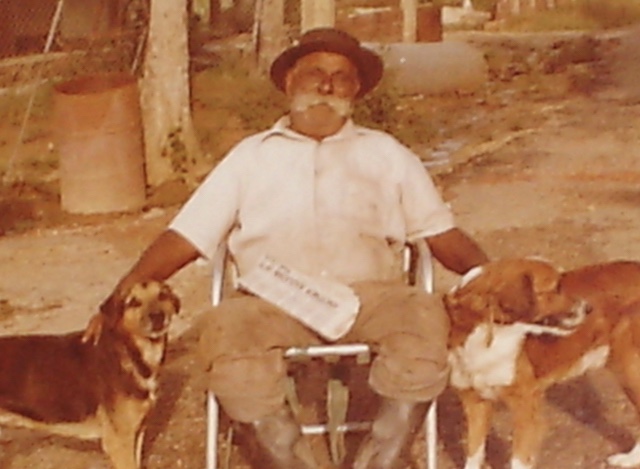
Shoes were optional.  We wore them with tall white socks held up by rubber bands to school each weekday but every other occasion warranted only sturdy feet.  Our Sundays were punctuated by visits to The Garden. As soon as we pulled up in Tanti’s car we would burst out and take off running on the dirt traces.  A favorite spot was to run down the hollow, a long downward sloping hill just off the pig pens that would take you to the mango trees, the bamboo, the cane, the river and the world. .  We would run down and up as fast as we could to enjoy the freedom and the breeze.  Nana would greet us surrounded by his many dogs.  His short sleeve shirts were always open at the bottom revealing his big brown belly.  His weather beaten face housed a huge, grey handle-bar mustache and his almost bald head covered by a sweat stained, wide brim fedora.  He always wore rubber boots without socks and held his work pants up with a piece of sturdy string instead of a belt.  This was his seven days a week outfit.  While the adults chatted and cooked we kids had the run of the place.  The derrick, tractor and farm tools were our toys.  Swinging on the derrick arm and climbing on the tractor were favorite group activities with few casualties except for Brenda who almost poked her eye out once and another time got her leg stuck in the tractor.  This was no deterrent to our fun.  When food was ready we would eat on fig leaves.  The leaves of the banana trees, or figs as we called them, are deep green in color with a ridge in the middle; and a perfect smoothness and width for holding with one hand.  They make a perfect disposable plate or plates as one leaf was large enough to make several.  No cutlery was required as we ate with our dirty fingers; probably a pelau made with rice and beans and maybe chicken.  Sometimes we would rustle up a cricket game or visit the pigs or the cows.  To the opposite side of Nana’s house was the cattle pasture.  It was surrounded by tall teak trees and a wire fence to contain the cows and sometimes a bull.  We never set foot in the pasture but would call out to the animals from outside on the trace.  The goats had free reign and their poop were pea sized, black and marble shaped which reminded us of chick peas or channa.

I vividly remember the smell of Sunday – cow manure, pigpen, goat channa, machinery and earth.  The animal odors mixed with the machinery smells and dirt and joy and laughter made our Sundays extraordinary and so memorable.  Occasionally, when I am someplace rural and the smells align just so, it takes me back to that complex Sunday fragrance, a mix of the tangible and intangible.  It’s the smell of days that will never come again, youth and innocence and comfort and family.  That’s the smell of Sunday at The Garden. 

Come to The Garden

Nana and Nani bought a sugar cane estate in 1945.  The purchase price for the 365 acres was $9500.  They put a down payment of $4000 and paid 6% interest on the balance.  Nana related to me that he paid about $1000 annually and paid off the loan in about six years.  The math is a little fuzzy but demonstrates the tenacity of our indentured servant predecessors.  Indentured servitude is a euphemism for slavery.  You essentially sold yourself to a plantation owner for five years and lived in inhospitable barracks on the property for the duration of your contract. The indentured servants traveled in the belly of former slave ships, in cramped, insufferable conditions but because they were coerced or volunteered, did not have to be chained. My maternal grandmother (whom we called Nani) was born, on the ship, on the six month voyage from India to Trinidad. I don’t know much about her childhood other than the fact that she and Nana were betrothed as children and then, as adults, after they established their household, she and Nana continued the tradition of their parents and worked as laborers in the sugar cane fields in Trinidad. They were required to cut “a task” of cane which would take all day, and be paid .30c, only if they finished.  Most days Nana could finish his task then go help Nani so they would earn .60c daily.  If you do the math the down payment of $4000 requires about 13,000 hours of labor.  However, sometime early in their marriage they bought a small board house, as Nana called it, in McBean Village, Couva for $65.  This small wooden house was converted into living space and a dry goods store and that’s where the bulk of their money was earned.  They bought this house during WWII when commodities were scarce  The shop did so well (there were rumors about Black Market business) that bureaucrats came to investigate one year, but upon seeing the run down shack of a store, resolved that it was probably a mistake and left our grandparents alone. The estate purchased was called Mayvale and was bought from a German by the name of Major Kendall.  The white house on the property dated from the 17th century and had a cistern and wraparound verandah.  Mammy recalled, as a child, she would run around the rooms and get lost because the house was so large.  The estate’s main crop was sugar cane but there were also mangoes, pineapples and cashew trees as I recall.  Nana turned the barracks, formerly occupied by slaves and then indentured servants, into a pig pen.  When the other villagers heard about the purchase they teased Nana saying, “Ramserran buyin’ jungle” but he worked tirelessly seven days a week to make it prosper. 

We called it The Garden because to grow things back then was called, making garden.  We visited The Garden most Sundays driven by our Tanti Basdai in her old Morris Minor.  It fit 10 comfortably if we sat on each other’s laps, the floor and lay across the back window.  If you sat on the floor you had to be careful not to stick your hand or foot through the holes in the floorboards.  We’d travel with all our supplies to cook a delicious meal, and if we were lucky, make some coconut ice cream in the hand crank barrel.  The colonial mansion was long gone by the time we enjoyed Sundays there; replaced by a less elegant two story stilt board house built with no sense of architectural design or safety.  Under the house was crowded by tractors, machinery, tools and the not unpleasant smell of dirt, grease and sweat. Just outside the house lived the towering derrick for hauling cane.  Upstairs was a living room, bedrooms and a floating kitchen.  I call it a floating kitchen because it protruded out from the living room like an appendage, anchored by nothing and at one point, understandably, started tilting downward to earth.  We kids were not allowed in the kitchen due to the danger and I remember sitting in the living room watching as the adults carefully scurried around preparing meals on the sloping floors.  It was a given that the kitchen would eventually fall and when it did no one was surprised and miraculously no one was hurt.  The notion was that things were used until they were no longer useful then left to go back to nature.  The estate was littered with rusting, obsolete machinery, material, and the structure of a fallen down old kitchen, baking in the sun, waiting to be swallowed up by the jungle.  Nana was a no nonsense guy therefore his bedroom was spartan and dominated by a bed on blocks.  Nana elevated the bed so he could watch the fields at night through the bedroom window.  He was nighttime security.  A sardine can was placed under each of the four legs of the bed to prevent insects from crawling up. The can was filled with water (or maybe pitch-oil) so that any insect that tried to crawl up the leg into the bed would fall into the can and drown.

Our Sunday visits…to be continued

Memphis – The Place of King

Graceland calls.  Yes, it’s a three hour drive from Nashville but it’s on my bucket list.  10 minutes on the highway, outside of Memphis, the idiot lights on the rental car start flashing.  It says refer to manual.  Of course there’s no manual in the glove box so I google the code.  Something to do with the brakes!!! I ask Rich if the brakes are working, he responds, “I haven’t had to use them yet” sigh.  Luckily we are right outside of the Memphis airport and very easily are able to stop and swap the car for another.  This must happen often because the rental car people didn’t blink an eye. 

Graceland is not just a mansion, it’s an experience.  Across from the mansion is a complex devoted to marketing everything Elvis. My vision was that we would pop into the mansion, past the famous iron gates with the music notes, and peruse the house.  Nooooo, one must buy a pricey ticket for a self-guided ipad tour and get on a minibus that drives you literally across the street to crowds and lines in the heat.  We wait in the sun patiently taking many, many pictures before we make it inside.  Tourists are allowed to walk through the first floor and the basement.  The upstairs is reserved for visiting family members like Priscilla and Lisa Marie. The rooms are preserved in time circa 1960’s to 1970’s.  An ENTIRELY white living room—10 foot sofa and carpet welcomes us, well maybe not us because white has never been our color as it becomes easily accented with our stains and finger prints and the velvet rope tells us to stay back.  Elvis probably was not planning on having children when he and his parents moved in.  Downstairs is all brocaded drapes, crystal chandeliers and stained glass peacock windows.  Elvis’s parents’ bedroom is accented in purple.  He lived here with his parents because he bought the house when he was only 21. Hmmm, note to self, children buy their parents houses when they’re 21.  Clearly Elvis and I are the same.  His kitchen and basement have the same wood paneling we had in Queens in the 1970’s.  The poodle wallpaper is similar to the raised red velvety fleur de lis wallpaper we had in Queens too.  OMG, we had the same TV and dark, shag carpet as his Jungle room.  Elvis’ house reminds me so much of my childhood down to the cheap metal swing set out back. Lisa Marie and I could have had sleepovers! We leave the complex after visiting the poolside Mausoleum where Elvis, his twin brother and his parents are interred.  Not really a place to take a swim but gives a whole new meaning to the term infinity pool.  The minibus rolls us back across the street to the sprawling “complex” which has restaurants, exhibits, cars, planes, a movie theater, and multiple gift shops.  It’s too much to see in one day so we buy a couple of Tshirts and call it done.   

Memphis is THE place for BBQ.  We find a yelp reviewed joint a few minutes from Graceland.  The lady behind the counter expertly orders for me and calls me honey.  Ribs for two with coleslaw and potato salad.  She takes one look at Rich and notes  “mild” BBQ sauce; he’s the only white guy in the place.  They stop taking orders after us and send people away.  17 orders is their limit and customers wait patiently for their food.  We snag a table and eat the most delicious, falling off the bone ribs.  There’s a man staring at me through the window outside.  He makes me uncomfortable but I ignore him and notice that he comes inside; probably just another hungry customer. He announces to no one in particular that he’s lonely and doesn’t have a girlfriend and then proceeds to have a loud conversation with himself. One generous patron drops some change in front of him and tells him to put it towards a burger.  He continues talking then notices some young girls by the register.  He changes his seat and then comments to them about how pretty they are.  One girl makes the mistake of looking at him and thanking him.  He gets up and stands next to her. She tries to ignore him but he continues to discuss how he needs a girlfriend, more to himself but clearly making her and her friend uncomfortable by standing very close.  The cook emerges from the back, has a few terse words with him, and chases him out the door.  As the cook returns and calmly walks past me I notice a gun in his waistband.  It was clearly the reason why the man with no girlfriend left.  I consider the situation.  Rich and I look at each and, in unspoken understanding, agree that the ribs are just too delicious to abandon due to the threat of gun violence so we continue to eat the delectable BBQ.   

Extraordinary Grace

Phelps lane peewee softball mid-week, 7pm and I’m wishing I was home; all the 3rd grade girls are out on the field.  The outfielders, my daughter included, are leisurely plucking dandelions and occasionally looking up to field a ball.  I’m trying to pay attention to the less than riveting game while keeping my son and his sister occupied.  Gradually I notice the outfielders’ come to attention.  Almost in unison, something they’ve never done at practice, they move their bodies and turning their backs on the batter, look east, just like the moment in Swan Lake when all the swans turn to the sun.  My eyes, then head, follow their gazes.  They are entranced because, over by the annex building, a car is on fire.  There is a thick haze of black smoke and then flames slowly start to shoot from the car.  We are all frozen in place watching the destruction. I gaze over at the smoldering car, fascinated, and think, what an unlucky break.    I look further and think almost abstractly, “hmmm I’m parked over there,” and then, with alarm, “SHIT I’M PARKED OVER THERE!” I leave my softball player where she is, as she’s supervised by her coaches, and grab the hands of my son and daughter and book it closer to the fire.  I weave my way through the crowd, dragging them with me, to look at the car that’s on fire; it’s a sedan not a silver minivan.  It’s almost a relief that it’s not mine BUT, on closer inspection, realize that I’m unluckily parked next to the car now engulfed in flames.  I don’t know what to do and start to panic.  I quickly weigh my options.  I can try to jump into the minivan and drive it away but I would have to either leave my little ones behind in the crowd or take them into the van with me.  It’s Sophie’s choice.  The flames are getting higher and hotter and the crowd is backing away and waiting for the fire department.  I imagine that I hear fire trucks off in a distance but my van is slowly being licked by the flames.  Oh My God!!  I need to move my van.  I say it out loud without thinking, trying to make a decision.  A stranger walks over to me and says, “I’ll move your car, give me the keys.” I obey without thinking.  I hand the keys over and watch as he hops into the driver’s seat and quickly and expertly backs the van away from the flames.  It takes seconds.  He walks over to me and hands me my keys with the fob attached to three adorable pictures of my elementary aged kids.  I barely look up before he disappears.  I don’t think I even thanked him before he melts into the crowd.  I didn’t see his face or ask his name but I do know for sure that he’s an angel.  He swooped down in my time of distress and saved me.  Tennessee Williams famously wrote, “I’ve always depended on the kindness of strangers” and it resonates with me as sometimes, in the unlikeliest times, strangers seem to dive in and help without me asking, thanking or perhaps even deserving.  I am gratefully surrounded by extraordinary grace. 

Richard III

He was born at 42 weeks. After several false alarms my doctor jiggled things around and with the help of some drugs he came into the world, finally. He was my third and the only one I remembered to sing Happy Birthday to right after delivery, on his true birthday. They brought him to me and as he reached out of the swaddling blankets I flinched. His hand was not only enormous, but blue. It reminded me of the show “Chiller Theater” where a creepy six fingered hand reaches out of the ground in the opening credits. The next day Dr. Reyes assured me that it was just like puppies – big paws meant he would grow into a big boy. And he did, 6’2” at the last telling. You’re welcome for those long legs 🙂

He was the easiest baby and the most diplomatic.  While his eldest sister’s first word was “da” and his almost twin sister’s was “ma”, his was the middle of the road “ba”, showing no favorites.  He was and still is a happy child and young man.  He smiled early and often.  He would wake up smiling, sleeping with his hands clasped behind his head.  He kept his room organized, read voraciously and is so incredibly thoughtful.  He would refuse to part with his old clothes or toys because he attached a special memory to everything.  He would even save the wrapping paper from his gifts.  He cried so much when we put our old, denim couch on the curb that I had to cut a swatch of it and make him a pillow.  He loved his pink rose flannel sheets and would carry the pillow, that he called Rosy, on many trips.  He loves to travel but many times is oblivious to the destination, asking while in the car, “where are we going?”

He is so intelligent. I had to limit him to check out only the library books he could carry every week when he was in elementary school. His teachers loved him and wrote glowing comments but they noticed the perseveration. He can get caught up so much in his work that he is sometimes paralyzed and overwhelmed. Ironically, he compensates for this by procrastination. And, most infuriating, is that this last minute strategy always works out; reinforcing this terrible habit. He presents himself with such confidence and a sense of humor that people want to help him out. In middle school he discovered chess, bringing his chess board to the dances, and was one of the youngest players at the weekly library chess club. I would drop him off and watch as he mingled with adult players with ease; so comfortable in his own skin.

I thought college would be a breeze.  But apparently triple majoring in STEM during a pandemic is not easy.  Yet, despite some underwhelming grades, he manages to make Dean’s list every year.  His tenacity is impressive.  He developed back problems as a teen.  Nothing breaks your heart like watching your beautiful son hunched over in pain walking with a cane and taking exams lying on the floor of their classroom or hiking Kokohead in Hawaii hobbled by pain.  For that alone he deserves to be on the Dean’s list. 

He’s been an Engineer since he was in Elementary school, starting with his fascination with refrigerator motors in the first grade to his love of Physics in middle school and to recently teaching himself to repair and bring an old car back to life. He loves his sisters, although he cried over how mean they were when he was younger, he’s the glue that holds them together.  I don’t know where he’s going from here but he’s always wanted to work in Aerospace so it’s only going to be up. 

Nashville

We touch down at BNA after 9pm.  There’s a band playing at Tootsie’s Orchid Lounge right outside of the gate.  Welcome to Music City. 

The first morning we end up in Athens, the Athens of the south that is, and tour the Parthenon.  It is a life size replica of the one in Greece and is monstrous with a zillion foot gold Athena guarding a serpent deep inside the temple.  The columns outside dwarf anyone who stands next to them. 

We try Three Brothers Coffee a few minutes away from Athena.  The coffee is strong and the tip cup reminds us that “doves will cry” if we don’t tip, so we do. 

 That afternoon we head to Mount Juliet to visit Tom, the main reason for our trip.  The winding roads lead to the edge of the Cumberland River.  Squirrels scurry out among the trees and one jostles and makes a break for the other side of the road.  Tennessee squirrels are no different from any other state; they play chicken and always manage to make it to the other side, dodging oncoming cars.  One brown one eyes us warily, assesses the odds, and then darts in front of us.  I feel the thump before I hear it.  The odds were not in his favor. 

Santa’s workshop is typically southern.  There are several cars in various stages of use/repair parked out front.  The breezeway between the ranch style house and the garage is populated with wind chimes. Through it I can see the river, an expansive lawn and a dock in need of repair.  There is a gated garden with perfect sunlight to the right gone to weed.  We walk in and Tom rises from his wheelchair to bear hug us.  The best he can do is stand.  The stroke has affected his left side, and oddly, his right eye.  The hunting, fishing and cooking days are paused but he still manages to put together a smoked butt and his famous coleslaw.  His girlfriend has become his sous chef and devoted live in companion.  We feast and chat just like old times.  Tom is still a wonderful storyteller and even has stroke stories that are incredibly funny.  He turns the sadness of his new disability into humor but there is an underlying hum of fear and resignation.  Buying into stereotypes, I would have guessed Nascar but Tom is actually a devoted Hockey fan.  We notice next to the couch an enormous, framed hockey jersey with the name Santa on the back and signed by all the players of the Tennessee team; a gift from a friend that Tom hasn’t been able to hang on the wall.  It’s been sitting patiently for many months on the floor.  I decide then and there that Rich is going to volunteer to hang it. 

We have tickets to the Grand Ole Opry!  Tom tries to get out of it and even offers to send his girlfriend on a weird, awkward sister wives date but I talk Tom into going with us.  The wheelchair limits his mobility but the Opry people assure me that they are very accommodating.  It’s Rich’s job to push Tom’s wheelchair.  We meet them in the parking lot. The parking lot attendant enthusiastically golf carts us to the entrance and the ushers open a large door to accommodate Tom’s chair.  We are escorted to an elevator and then to a wheelchair lift.  Everything is going smoothly until the lift breaks.  From the top of the stairs I see the lift go up halfway, shudder, then go down again.  This happens twice. Maybe it wasn’t the best idea to have Rich and Tom ride the lift.  The Opry people assure us that maintenance is on their way.  It’s close to curtain time so the manager comes over and offers us better seats in another section with a working lift.  Rich makes me ride the second lift with Tom. I suggest to Tom that he keep breaking things till we get to the front row.  Tom takes it all in stride, but I know this inconvenience reinforces his reticence.  The show, however, is AMAZING!! There’s a radio host as an MC because each show is broadcast on the radio.  The lineup is singer, comedian, singer, guitarist, and Terry Bradshaw and his daughter making her Opry debut.  Wait, isn’t Terry a football player? He can sing?? He sings better than his daughter.  I google him—he’s released several albums.  Each performer performs three songs (one song is mandated to be done without the support of the Opry orchestra to weed out the lesser talented I guess); every performer is talented.   We part ways after wheeling Tom over the covered bridge to his car.  I’m nervous as I see him slowly get into the driver’s seat but he makes it home safely. 

The next day we head to Memphis.  That is a story for another day.