Even though the estate was purchased early on in their marriage, the family never lived there. Nana stayed in Santa Clara to manage the day to day operation of sugar cane farming and came to visit his family in McBean often enough to ensure a baby every year, there were eleven births in total. Nani carried on the shop and raised the children mostly alone until Tanti Basdai was old enough to help. Nana would visit consistently to count and collect the receipts. These visits were frequently acrimonious as Nani would try to hide and hold on to any profits to pay for household expenses but, after the occasional violent struggle, Nana would prevail. The McBean house was one of practicalities but no luxuries; even mirrors, whose sole purpose was vanity, were nowhere to be found. We were raised blissfully unaware of the history but knew the McBean house as a place of strict “sit down on a bag” rules imposed by Tanti, as Nani had died long before, while The Garden was a place of joy.
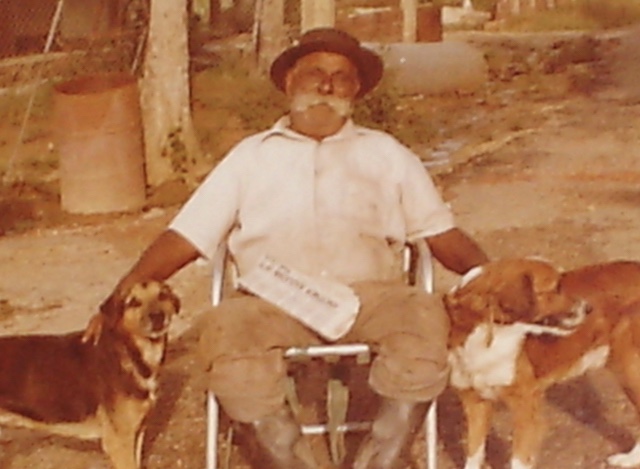
Shoes were optional. We wore them with tall white socks held up by rubber bands to school each weekday but every other occasion warranted only sturdy feet. Our Sundays were punctuated by visits to The Garden. As soon as we pulled up in Tanti’s car we would burst out and take off running on the dirt traces. A favorite spot was to run down the hollow, a long downward sloping hill just off the pig pens that would take you to the mango trees, the bamboo, the cane, the river and the world. . We would run down and up as fast as we could to enjoy the freedom and the breeze. Nana would greet us surrounded by his many dogs. His short sleeve shirts were always open at the bottom revealing his big brown belly. His weather beaten face housed a huge, grey handle-bar mustache and his almost bald head covered by a sweat stained, wide brim fedora. He always wore rubber boots without socks and held his work pants up with a piece of sturdy string instead of a belt. This was his seven days a week outfit. While the adults chatted and cooked we kids had the run of the place. The derrick, tractor and farm tools were our toys. Swinging on the derrick arm and climbing on the tractor were favorite group activities with few casualties except for Brenda who almost poked her eye out once and another time got her leg stuck in the tractor. This was no deterrent to our fun. When food was ready we would eat on fig leaves. The leaves of the banana trees, or figs as we called them, are deep green in color with a ridge in the middle; and a perfect smoothness and width for holding with one hand. They make a perfect disposable plate or plates as one leaf was large enough to make several. No cutlery was required as we ate with our dirty fingers; probably a pelau made with rice and beans and maybe chicken. Sometimes we would rustle up a cricket game or visit the pigs or the cows. To the opposite side of Nana’s house was the cattle pasture. It was surrounded by tall teak trees and a wire fence to contain the cows and sometimes a bull. We never set foot in the pasture but would call out to the animals from outside on the trace. The goats had free reign and their poop were pea sized, black and marble shaped which reminded us of chick peas or channa.
I vividly remember the smell of Sunday – cow manure, pigpen, goat channa, machinery and earth. The animal odors mixed with the machinery smells and dirt and joy and laughter made our Sundays extraordinary and so memorable. Occasionally, when I am someplace rural and the smells align just so, it takes me back to that complex Sunday fragrance, a mix of the tangible and intangible. It’s the smell of days that will never come again, youth and innocence and comfort and family. That’s the smell of Sunday at The Garden.
 unbecomingjane
So enjoyable reading about our experiences. You captured our Sundays at the garden. Thank you!
LikeLiked by 1 person
You’re welcome!! There are so many memories.
LikeLike
The essence of our youth❤️
LikeLike
True. I miss those days.
LikeLike